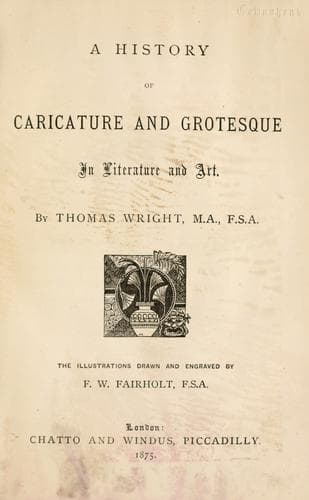
A History of Caricature and Grotesque in Literature and ArtWright, Thomas
History
A History of Caricature and Grotesque in Literature and Art
Wright, Thomas
Caricature -- History
"There was a priest of a village who was as proud as might be,
because he had seen a little more than his Cato; for he had read
_De Syntaxi_, and his _Fauste precor gelida_ [the first eclogue
of Baptista Mantuanus]. And this made him set up his feathers,
and talk very grand, using words that filled his mouth, in order
to make people think him a great doctor. Even at confession, he
made use of terms which astonished the poor people. One day he
was confessing a poor working man, of whom he asked, 'Here, now,
my friend, tell me, art thou ambitious?' The poor man said 'No,'
thinking this was a word which belonged to great lords, and almost
repented of having come to confess to this priest; for he had
already heard that he was such a great clerk, and that he spoke
so grandly, that nobody understood him, which he now knew by this
word _ambitious_; for although he might have heard it somewhere,
yet he did not know at all what it was. The priest went on to
ask 'Art thou not a fornicator?' 'No,' said the labourer, who
understood as little as before. 'Art thou not a gourmand?' said
the priest. 'No.' 'Art thou not superbe [_proud_]?' 'No.' 'Art
thou not iracund?' 'No.' The priest seeing the man answer always
'No,' was somewhat surprised. 'Art thou not concupiscent?' 'No.'
'And what art thou, then?' said the priest. 'I am,' said he, 'a
mason; here is my trowel!'"
At this time "Pantagruelism" had mixed itself more or less largely in
all the satirical literature of France. It is very apparent in the
writings of Bonaventure des Periers, and in a considerable number of
satirical publications which now issued, many of them anonymously, or
under the then fashionable form of anagrams, from the press in France.
Among these writers were a few who, though far inferior to Rabelais,
may be considered as not unequal to Des Periers himself. One of the
most remarkable of these was a gentleman of Britany, Noel du Fail, lord
of La Hérissaye, who was, like so many of these satirists, a lawyer,
and who died, apparently at an advanced age, at the end of 1585, or
beginning of 1586. In his publications, according to the fashion of
that age, he concealed his name under an anagram, and called himself
Leon Ladulfil (doubling the _l_ in the name Fail). Noel du Fail has
been called the ape of Rabelais, though the mere imitation is not very
apparent. He published (as far as has been ascertained), in 1548,
his "Discours d'aucuns propos ruftiques facétieux, et de singulière
récréation." This was followed immediately by a work entitled
"Baliverneries, ou Contes Nouveaux d'Eutrapel;" but his last, and most
celebrated book, the "Contes et Discours d'Eutrapel," was not printed
until 1586, after the death of its author. The writings of Noel du Fail
are full of charming pictures of rural life in the sixteenth century,
Public-domain text, read in full here on John Shaqi.
Reviews
Reviews
No reviews yet
Be the first to share your thoughts on this work.
Elsewhere in the archive
Join the Discussion
Join the discussion
Sign in to leave a comment or review.
Sign InorCreate an account