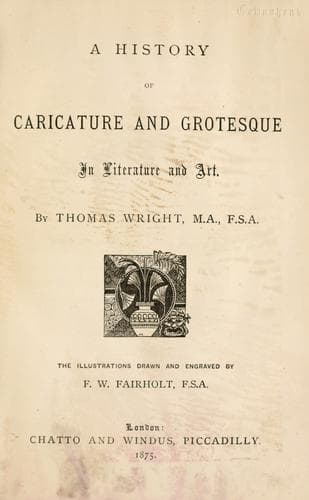
A History of Caricature and Grotesque in Literature and ArtWright, Thomas
History
A History of Caricature and Grotesque in Literature and Art
Wright, Thomas
Caricature -- History
and, though sufficiently free, they present less than most similar
books of that period of the coarseness of Rabelais. I cannot say the
same of a book which is much more celebrated than either of these,
and the history of which is still enveloped in obscurity. I mean the
"Moyen de Parvenir." This book, which is full of wit and humour, but
the licentiousness of which is carried to a degree which renders it
unreadable at the present day, is now ascribed by bibliographers, in
its present form, to Béroalde de Verville, a gentleman of a Protestant
family who had embraced Catholicism, and obtained advancements in the
church, and it was not printed until 1610, but it is supposed that in
its present form it is only a revision of an earlier composition,
perhaps even an unacknowledged work of Rabelais himself, which had been
preserved in manuscript in Beroald's family.
Pantagruelism, or, if you like, Rabelaism, did not, during the
sixteenth century, make much progress beyond the limits of France.
In the Teutonic countries of Europe, and in England, the sceptical
sentiment was small in comparison with the religious feeling, and the
only satirical work at all resembling those we have been describing,
was the "Utopia" of Sir Thomas More, a work comparatively spiritless,
and which produced a very slight sensation. In Spain, the state of
social feeling was still less favourable to the writings of Rabelais,
yet he had there a worthy and true representative in the author of
Don Quixote. It was only in the seventeenth century that the works of
Rabelais were translated into English; but we must not forget that our
satirists of the last century, such as Swift and Sterne, derived their
inspiration chiefly from Rabelais, and from the Pantagruelistic writers
of the latter half of the sixteenth century. These latter were most of
them poor imitators of their original, and, like all poor imitators,
pursued to exaggeration his least worthy characteristics. There is
still some humour in the writings of Tabourot, the sieur des Accords,
especially in his "Bigarrures," but the later productions, which
appeared under such names as Bruscambille and Tabarin, sink into mere
dull ribaldry.
Public-domain text, read in full here on John Shaqi.
Reviews
Reviews
No reviews yet
Be the first to share your thoughts on this work.
Elsewhere in the archive
Join the Discussion
Join the discussion
Sign in to leave a comment or review.
Sign InorCreate an account