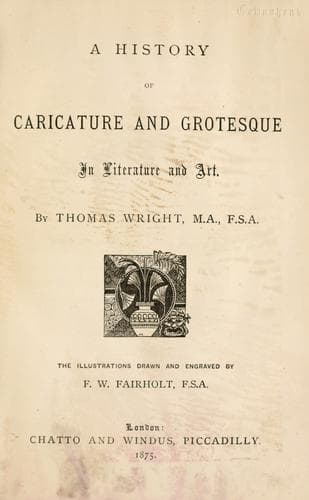
A History of Caricature and Grotesque in Literature and ArtWright, Thomas
History
A History of Caricature and Grotesque in Literature and Art
Wright, Thomas
Caricature -- History
There had arisen, however, by the side of this satire which smelt
somewhat too much of the tavern, another satire, more serious,
which still contained a little of the style of Rabelais. The French
Protestants at first looked upon Rabelais as one of their towers of
strength, and embraced with gratitude the powerful protection they
received from the graceful queen of Navarre; but their gratitude
failed them, when Marguerite, though she never ceased to give them her
protection, conformed outwardly, from attachment to her brother, to the
forms of the Catholic faith, and they rejected the school of Rabelais
as a mere school of Atheists. Among them arose another school of
satire, a sort of branch from the other, which was represented in its
infancy by the celebrated scholar and printer, Henri Estienne, better
known among us as Henry Stephens.
The remarkable book called an "Apologie pour Herodote," arose out of
an attack upon its writer by the Romanists. Henri Estienne, who was
known as a staunch Protestant, published, at great expense, an edition
of Herodotus in Greek and Latin, and the zealous Catholics, out of
spite to the editor, decried his author, and spoke of Herodotus as a
mere collector of monstrous and incredible tales. Estienne, in revenge,
published what, under the form of an apology for Herodotus, was really
a violent attack on the Romish church. His argument is that all
historians must relate transactions which appear to many incredible,
and that the events of modern times were much more incredible, if
they were not known to be true, than anything which is recorded by
the historian of antiquity. After an introductory dissertation on the
light in which we ought to regard the fable of the Golden Age, and on
the moral character of the ancient peoples, he goes on to show that
their depravity was much less than that of the middle ages and of his
own time, indeed of all periods during which people were governed by
the Church of Rome. Not only did this dissoluteness of morals pervade
lay society, but the clergy were more vicious even than the people, to
whom they ought to serve as an example. A large part of the book is
filled with anecdotes of the immoral lives of the popish clergy of the
sixteenth century, and of their ignorance and bigotry; and he describes
in detail the methods employed by the Romish church to keep the mass
of the people in ignorance, and to repress all attempts at inquiry.
Out of all this, he says, had risen a school of atheists and scoffers,
represented by Rabelais and Bonaventure des Periers, both of whom he
mentions by name.
Public-domain text, read in full here on John Shaqi.
Reviews
Reviews
No reviews yet
Be the first to share your thoughts on this work.
Elsewhere in the archive
Join the Discussion
Join the discussion
Sign in to leave a comment or review.
Sign InorCreate an account