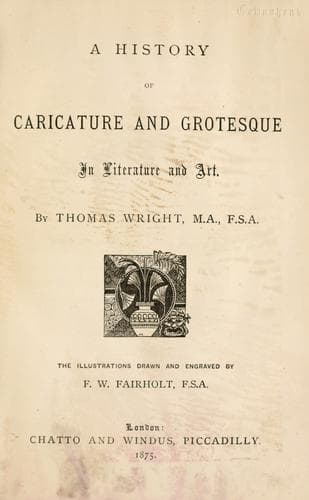
A History of Caricature and Grotesque in Literature and ArtWright, Thomas
History
A History of Caricature and Grotesque in Literature and Art
Wright, Thomas
Caricature -- History
"The Alchemist," by the same author, preceded "Bartholomew Fair," by
four years, and was designed as a satire upon a class of impostors
who, in that age, were among the greatest pests of society, and were
instruments, one way or other, in the greatest crimes of the day.
"The Alchemist" belongs, also, to the pure English comedy, but its
plot is more simple and distinct than that of "Bartholomew Fair." It
involves events which may have occurred frequently, at periods when the
metropolis was from time to time exposed to the vicissitudes of the
plague. On one of these occasions, Lovewit, a London gentleman, obliged
to quit the metropolis in order to avoid the plague, leaves his town
house to the charge of one man-servant, Face, who proves dishonest,
associates himself with a rogue named Subtle, and an immoral woman
named Dol Common, and introduces them into the house, which is made the
basis for their subsequent operations. Subtle assumes the character of
a magician and alchemist, while Dol acts various female parts, and Face
goes about alluring people into their snares. Among their dupes are a
knight who lives upon the town, two English Puritans from Amsterdam, a
lawyer's clerk, a tobacco man, a young country squire, and his sister
dame Pliant, a widow. The various intrigues in which these individuals
are involved, show us the way in which the pretended conjurers and
alchemists contributed to all the vices of the town. At length their
base dealings are on the point of being exposed by the cunning of
one upon whom they had attempted to impose, when Truewit, the master
of the house, returns unexpectedly, and all is discovered, but the
alchemist and his female associate contrive to escape. The object of
their last intrigue had been to entrap dame Pliant, who was rich, into
a marriage with a needy sharper; and Lovewit, finding the lady in the
house, and liking her, marries her himself, and, in consideration of
the satisfaction he has thus procured, forgives his unfaithful servant.
Many have considered the Alchemist to be the best of Jonson's dramas.
"Epicœne, or the Silent Woman," which belongs to the year 1609, is
another satirical picture of London society, in which the same class of
characters appear. Morose, an eccentric gentleman of fortune, who has
a great horror for noise, and even obliges his servants to communicate
with him by signs, has a nephew, a young knight named Sir Dauphine
Eugenie, with whom he is dissatisfied, and he refuses to allow him
money for his support. A plot is laid by his friends, whereby the uncle
is led into a marriage with a supposed silent woman, named Epicœne,
but she only sustains the character until the wedding formalities
are completed, and these are followed by a scene of noise and riot,
which completely horrifies Morose, and leads to a reconciliation with
his nephew, to whom he makes over half his fortune. The earliest of
Ben Jonson's comedies, "Every Man in his Humour," was composed in
Public-domain text, read in full here on John Shaqi.
Reviews
Reviews
No reviews yet
Be the first to share your thoughts on this work.
Elsewhere in the archive
Join the Discussion
Join the discussion
Sign in to leave a comment or review.
Sign InorCreate an account