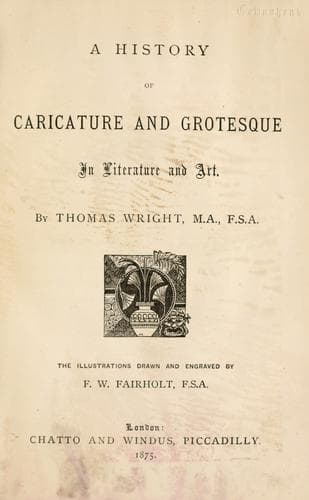
A History of Caricature and Grotesque in Literature and ArtWright, Thomas
History
A History of Caricature and Grotesque in Literature and Art
Wright, Thomas
Caricature -- History
as a simpleton from the country, longs for everything, and wonders at
everything, buys up toys and gingerbread, is separated from all his
companions, robbed of his money and even of his outer garments, and in
this condition finally settles down at a puppet-show. Meanwhile the
Puritan Busy, by his zeal against the "heathen abominations" of the
fair on one hand, and Waspe, by his quarrelsome temper on the other,
fall into a series of scrapes, which end in both being carried to the
stocks. They are there joined by another important personage. Justice
Overdo, who is distinguished by an extraordinary zeal for the right
administration of justice and the suppression of social vices of all
kinds, has come into the fair in disguise, in order to make himself
acquainted with its various abuses, and he passes among them unknown;
and his inquisitive intermeddling brings him into a variety of mishaps,
in the course of which he also is seized by the constable, and allows
himself to be taken to the stocks, rather than betray his identity.
Thus all three, Busy, Waspe, and Overdo, are placed in the stocks
at the same time; but Waspe, by a clever trick, escapes, and leaves
the Puritan and the justice confined together, the one looking upon
himself as a martyr for religion's sake, the other rather glorying in
suffering through his disinterested zeal for the common good. They,
too, after a while make their escape through an accidental oversight of
their keepers, and mix again with the mob. The women, likewise, have
been separated from their male companions, have fallen among sharpers
and bullies, been made drunk, and escaped but narrowly from still
worse disasters. They all finally meet before the puppet-show, which
has fixed the attention of Cokes, and there justice Overdo discovers
himself. Such are the materials of Ben Jonson's "Bartholomew Fair,"
the busiest and most amusing of plays. It is said, when first acted,
to have given great satisfaction to king James, by the ridicule thrown
upon the Puritans, and it continued to be a favourite comedy when
revived after the Restoration.
Public-domain text, read in full here on John Shaqi.
Reviews
Reviews
No reviews yet
Be the first to share your thoughts on this work.
Elsewhere in the archive
Join the Discussion
Join the discussion
Sign in to leave a comment or review.
Sign InorCreate an account