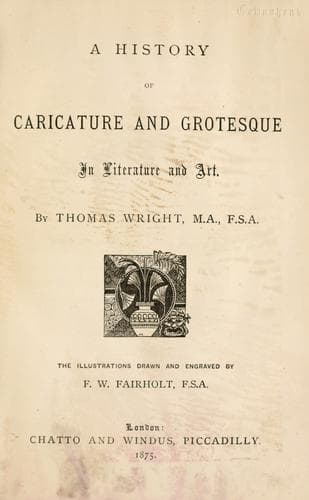
A History of Caricature and Grotesque in Literature and ArtWright, Thomas
History
A History of Caricature and Grotesque in Literature and Art
Wright, Thomas
Caricature -- History
home, and very ready to listen to the advances of the gay gallants
from the court end of the town, or from the tavern. The city tradesman
has generally an apprentice or two, sometimes very sober but perhaps
more frequently dissipated, who play their parts in the piece; and
often a daughter, who is either a model of modesty and all the domestic
virtues, and is finally the reward of some hero of good principles,
who has been temporarily led astray, and his character misinterpreted,
or who is gay and intriguing, and comes to disgrace. But the favourite
idea of excellence, or, to use a technical phrase, the _beau ideal_
of this comedy, appears to have been a wild youth, who goes through
every scene of dissipation, in a gentlemanly manner (as the term was
then understood), and comes out at the end of the play as an honest,
virtuous man, and receives the reward for qualities which he had not
previously displayed.
Sometimes the writers of this comedy indulged in personal, or even
in political, allusions which brought them into trouble. In the year
1605, Ben Jonson, George Chapman, and John Marston, wrote jointly a
comedy entitled "Eastward Hoe." It is a very excellent and amusing
comedy, and was very popular. Touchstone, an honest goldsmith in the
city, has two apprentices, Golding, a sober and industrious youth, and
Quicksilver, who is an irreclaimable rake. Touchstone has also two
daughters, the eldest of whom, Gertrude, affects the fine lady, and
is ambitious of finding a husband in the fashionable world, while her
younger sister, Mildred, is all virtue and humility. An attachment
arises between Golding and Mildred. Another character in this drama
is a needy, scheming knight, who lives upon the town, and rejoices in
the name of Sir Petronel Flash. Sir Petronel is attracted by the rich
dowry which the young lady, Gertrude, had to expect, pays his court
to her, and easily works upon her vanity; and, her mother encouraging
her, they are hastily married, contrary to the wishes of her father.
The knight is supposed to possess a magnificent castle somewhere to the
east of London, and the young bride and her mother proceed in search of
this, from which the comedy derives its title of "Eastward Hoe," but
they are involved in various disagreeable adventures in the search,
which ends in the conviction that it is all a fable. Another character
in the play is a greedy and unprincipled usurer, who is so jealous of
his young and pretty wife, that he keeps her under lock and key; and
this man is deeply involved in money-lending with Sir Petronel Flash,
and they are engaged in a series of unprincipled transactions, which
lead to the disgrace of them all, and in the course of which the virtue
of the usurer's wife falls a sacrifice. Meanwhile the fortunes of the
two apprentices have been advancing in directly opposite directions.
Quicksilver, the unworthy apprentice, leaves his master, proceeds
from bad to worse, and finally is committed to prison, for a crime
Public-domain text, read in full here on John Shaqi.
Reviews
Reviews
No reviews yet
Be the first to share your thoughts on this work.
Elsewhere in the archive
Join the Discussion
Join the discussion
Sign in to leave a comment or review.
Sign InorCreate an account