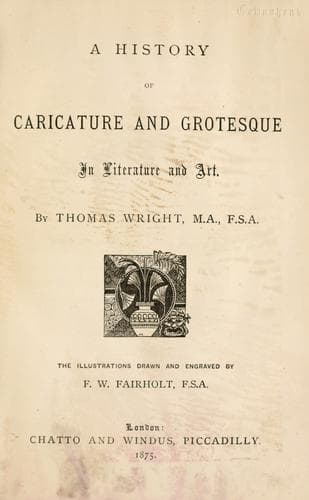
A History of Caricature and Grotesque in Literature and ArtWright, Thomas
History
A History of Caricature and Grotesque in Literature and Art
Wright, Thomas
Caricature -- History
the punishment of which was death. On the other hand, Golding has not
only gained his master's esteem and married his daughter Mildred, and
been adopted as the heir to his wealth, but he has merited the respect
of his fellow-citizens, and has been promoted in municipal rank. It
becomes Golding's duty to preside over the trial of his old fellow
apprentice Quicksilver, but the latter escapes through Golding's
generosity.
There is some sound morality in the spirit of this comedy, and a
very large amount of immorality in the text. There was, indeed, a
coarse licence in the relations of society at this period, which are
but too faithfully represented in its literature. But there are two
circumstances, accidentally attached to this drama, which give it
a peculiar interest. When brought out upon the stage it contained
reflections upon Scotchmen which provoked the anger of king James I.
to such a degree, that all the authors were seized and thrown into
prison, and narrowly escaped the loss of their ears and noses, but they
obtained their release with some difficulty, and only through powerful
intercession. In the copy which has been brought down to us through
the press, we find no reflections whatever upon Scotchmen, so that it
must have been altered from the original text. When we consider that,
at this time, the English court and capital were crowded with needy
Scottish adventurers, who were looked upon with great jealousy, it is
not improbable that in the original form of the comedy, Sir Petronel
Flash may have been a Scotchman, and intended not only as a satire upon
the Scottish adventurers in general, but to have been designed for some
one in particular who had the means of bringing upon the authors the
extreme displeasure of the court.
The other circumstance which has given celebrity to this comedy, is one
of still greater interest. After the Restoration, it was new modelled
by Nicholas Tate, and brought again upon the stage under the title of
"Cuckold's Haven." Perhaps through this remodelled edition, Hogarth
took from the comedy of "Eastward Hoe," the idea of his series of
plates of the history of the Idle and Industrious Apprentices.
Public-domain text, read in full here on John Shaqi.
Reviews
Reviews
No reviews yet
Be the first to share your thoughts on this work.
Elsewhere in the archive
Join the Discussion
Join the discussion
Sign in to leave a comment or review.
Sign InorCreate an account