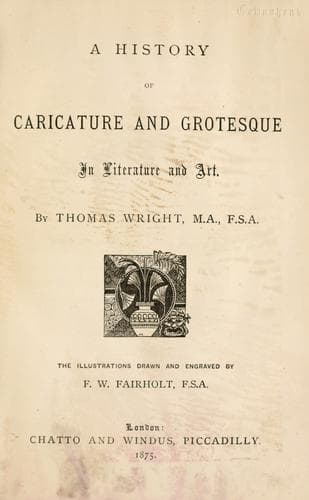
A History of Caricature and Grotesque in Literature and ArtWright, Thomas
History
A History of Caricature and Grotesque in Literature and Art
Wright, Thomas
Caricature -- History
Many of the dramatists of the Restoration were men of good and
aristocratic families, witty and profligate cavaliers, who had returned
from exile with their king. The family of the earl of Berkshire
produced no less than four writers of comedy, all brothers, Edward
Howard, colonel Henry Howard, sir Robert Howard, and James Howard,
while their sister, the lady Elizabeth Howard, was married to the
poet Dryden. Edward Howard's first dramatic piece was a tragi-comedy
entitled "The Usurper," which came out in 1668, and was intended as
a satire upon Cromwell. His best known comedies were "The Man of
Newmarket," and "Woman's Conquest." Colonel Henry Howard composed a
comedy entitled "United Kingdoms," which appears not to have been
printed. To James Howard, the youngest of the brothers, the play-going
public, even then rather a large one, owed "The English Mounsieur,"
and "All Mistaken, or the Mad Couple." Sir Robert Howard was the best
writer of the four, and wrote both tragedies and comedies, which were
afterwards published collectively. The best of his comedies is "The
Committee," which was first brought on the stage in 1665, and through
some chance, certainly not by its merit, continued to be an acting play
during the whole of the last century.
"The Committee" is by far the best of the dramatic writings of the
Howards. Its design was to turn to ridicule the Commonwealth men and
the Puritans. Colonel Blunt and colonel Careless are two royalists,
whose estates are in the hands of the committee of sequestrations,
and who repair to London for the purpose of compounding for them.
The chairman of the committee is a Mr. Day, a worldly-minded and
sufficiently selfish Puritan, but who is ruled by his more crafty and
still less scrupulous wife, a designing and very talkative woman. Both
are of low origin, for Mrs. Day had been a kitchen-woman, and both are
very proud and very tyrannical. Among the other principal characters
are Abel Day, their son, Obadiah, the clerk to the committee, a man in
the interest of the Days, and an Irish servant named Teague, who had
been the servant of Careless's dear friend, a royalist officer killed
in battle, and whom the colonel finds in great distress, and takes into
his own service out of charity. The character of Teague is a very poor
caricature upon an Irishman, and his blunders and bulls are of a very
spiritless description. Here is an example. Teague has overheard the
two colonels state that they should be obliged to take the Covenant,
and express their reluctance to do it, and in his inconsiderate zeal,
he hurries away to try if he cannot take the covenant for them, and
thus save them a disagreeable operation. In the street he meets a
wandering bookseller--a class of pedlars who were then common--and a
scene takes place which is best given in the words of the original:--
Public-domain text, read in full here on John Shaqi.
Reviews
Reviews
No reviews yet
Be the first to share your thoughts on this work.
Elsewhere in the archive
Join the Discussion
Join the discussion
Sign in to leave a comment or review.
Sign InorCreate an account