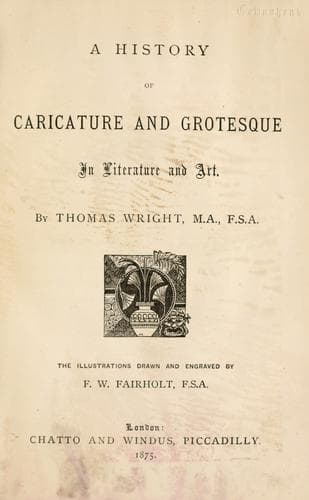
A History of Caricature and Grotesque in Literature and ArtWright, Thomas
History
A History of Caricature and Grotesque in Literature and Art
Wright, Thomas
Caricature -- History
When we consider the ridicule which was continually thrown upon them
in this earlier period of the English comedy, we can easily understand
the bitterness with which the Puritans regarded the stage and the
drama. When they obtained power, the stage, as might be expected, was
suppressed, and for some years England was without a theatre. At the
Restoration, however, the theatres were opened again, and with greater
freedom than ever. At first the old comedies of the days of James I.
and Charles I. were revived, and many of them, modified and adapted to
the new circumstances, were again brought upon the stage. The original
comedies which appeared immediately after the Restoration, were often
marked with a political tinge; as the stage saw its natural protectors
in the court, and in the court party, it embraced their politics; and
Puritans, Roundheads, Whigs, all whose principles were supposed to be
contrary to royalty and arbitrary power, fell under its satire. Such
was the character of the comedy of "The Cheats," by a play-writer of
some repute named Wilson, which was brought out in 1662. The object
of this play appears to have been, in the first place, to satirise
the Nonconformists or Puritanical clergy--with whom were classed the
astrologers and conjurers, who had increased in number during the
Commonwealth time, and infested society more than ever--and the city
magistrates, who were not looked upon as being generally over-loyal.
The three cheats who are the heroes of this comedy, are Scruple, the
Nonconformist, Mopus, a pretender to physic and astrology, and alderman
Whitebroth. Direct personal attacks had been introduced into the comedy
of the Restoration, and it is probable that somebody of influence was
satirised under the name of Scruple, for the play was suppressed by
authority, and at a later period, when it was revived, the prologue
announces this fact in the following words:--
_Sad news, my masters; and too true, I fear,
For us--Scruple's a silenc'd minister.
Would ye the cause? The brethren snivel, and say,
'Tis scandalous that any cheat but they._
Public-domain text, read in full here on John Shaqi.
Reviews
Reviews
No reviews yet
Be the first to share your thoughts on this work.
Elsewhere in the archive
Join the Discussion
Join the discussion
Sign in to leave a comment or review.
Sign InorCreate an account