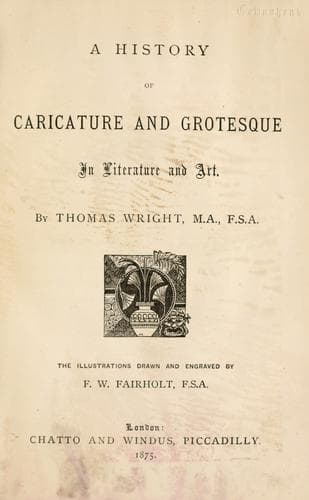
A History of Caricature and Grotesque in Literature and ArtWright, Thomas
History
A History of Caricature and Grotesque in Literature and Art
Wright, Thomas
Caricature -- History
"The Committee" is, after all, one of the very best comedies of the
school of dramatists represented by the brothers Howard. Contemporary
with this school of flat comedies, there was a school of equally
inflated tragedy, and both soon became objects of ridicule to the
satirists of the day. Of these, one of the boldest was George Villiers,
duke of Buckingham, the son of the favourite of king James I., and
equally celebrated for his talents and his profligacy. Buckingham is
said to have planned and begun his satirical comedy of "The Rehearsal"
as early as the year 1663, and to have had it ready for representation
towards the December of 1665, when the breaking out of the great plague
caused the theatres to be closed. After this interruption its author,
who was a desultory writer, appears to have laid it aside for some
time and then, new objects for satire having presented themselves, he
altered and modified it, and it was finally completed in 1671, when it
was brought out at the Theatre Royal in Covent Garden. It is said that
Buckingham was assisted in the composition of this satire, but it is
not stated in what manner, by Butler, and by Martin Clifford, of the
Charter-house. It is understood that, in the first form of his satire,
Buckingham had chosen the Hon. Edward Howard for its hero, and that he
afterwards exchanged him for Sir William Davenant, but he finally fixed
upon Dryden, whose tragedies and comedies are certainly not the best of
his writings--possibly some personal pique may have had an influence
in the selection. Nevertheless, with Dryden, the Howards, Davenant,
and one or two other writers of comedy, come in for their share of
ridicule. Dryden, under the name of Bayes, has composed a new drama,
and a friend named Johnson goes to witness the rehearsal of this play,
taking with him a country friend of the name of Smith. The play itself
is a piece of mockery throughout, made up of parodies, often very
happy, on the different play-writers of the day, and especially upon
Dryden; and it is mixed up with a running conversation between Bayes,
the author, and his two visitors, which is full of satirical humour.
The first part of the prologue explains to us sufficiently the spirit
in which this satire was written.
Public-domain text, read in full here on John Shaqi.
Reviews
Reviews
No reviews yet
Be the first to share your thoughts on this work.
Elsewhere in the archive
Join the Discussion
Join the discussion
Sign in to leave a comment or review.
Sign InorCreate an account