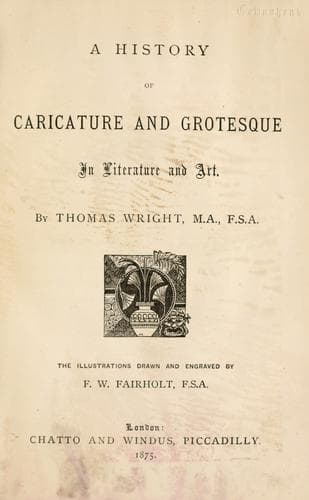
A History of Caricature and Grotesque in Literature and ArtWright, Thomas
History
A History of Caricature and Grotesque in Literature and Art
Wright, Thomas
Caricature -- History
up with street rows, capital satirical pictures of London life. The
play ends with marriages, and with the reconciliation of sir William
Rant with his father, the serious old gentleman of the play. Shadwell
excelled in these busy comedies. One of the nearest approaches to him
is Mountfort's comedy of "Greenwich Park," which is another striking
satire on the looseness of London life at that time. As in the others,
the plot is simply nothing. The play consists of a number of intrigues,
such as may be imagined, at a time when morality was little respected,
in places of fashionable resort like Greenwich Park and Deptford Wells.
An element of satire was now introduced into English comedy which does
not appear to have belonged to it before--this was mimicry. Although
the principal characters in the play bore conventional names, they
appear often to have been intended to represent individuals then well
known in society, and these individuals were caricatured in their
dress, and mimicked in their language and manners. We are told that
this mimicry contributed greatly to the success of "The Rehearsal,"
the duke of Buckingham having taken incredible pains to make Lacy, who
acted the part of Bayes, perfect in imitating the voice and manner
of Dryden, whose dress and gait were minutely copied. This personal
satire was not always performed with impunity. On the 1st of February,
1669, Pepys went to the Theatre Royal to see the performance of "The
Heiress," in which it appears that sir Charles Sedley was personally
caricatured, and the secretary of king Charles's admiralty has left
in his diary the following entry:--"To the king's house, thinking to
have seen the Heyresse, first acted on Saturday, but when we come
thither we find no play there; Kynaston, that did act a part therein
in abuse to sir Charles Sedley, being last night exceedingly beaten
with sticks by two or three that saluted him, so as he is mightily
bruised, and forced to keep his bed." It is said that Dryden's comedy
of "Limberham," brought on the stage in 1678, was prohibited after the
first night, because the character of Limberham was considered to be
too open a satire on the duke of Lauderdale.
Public-domain text, read in full here on John Shaqi.
Reviews
Reviews
No reviews yet
Be the first to share your thoughts on this work.
Elsewhere in the archive
Join the Discussion
Join the discussion
Sign in to leave a comment or review.
Sign InorCreate an account