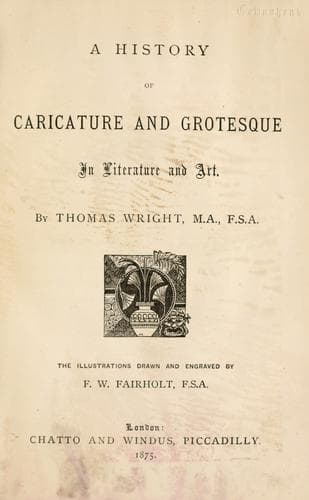
A History of Caricature and Grotesque in Literature and ArtWright, Thomas
History
A History of Caricature and Grotesque in Literature and Art
Wright, Thomas
Caricature -- History
The elder son of sir William Belfond has taken to Alsatia,
but sir William, on his return from abroad, hearing talk of the fame of
a squire Belfond among the Alsatians, imagines that it is his younger
son, and out of this mistake a considerable amount of misunderstanding
arises. At last sir William discovers his error, and finds his eldest
son in Whitefryers, but the youth sets him at defiance. The father, in
great anger, brings tipstaff constables, to take away his son by force;
but the Alsatians rise in force, the officers of the law are beaten,
and sir William himself taken prisoner. He is rescued by the younger
Belfond, and in the conclusion the elder brother becomes penitent, and
is reconciled with his father. There is an underplot, far from moral
in its character, which ends in the marriage of Belfond junior. It is
a busy, noisy play, and was a great favourite on the stage; but it is
now chiefly interesting as a vivid picture of London life in the latter
half of the seventeenth century. "Bury Fair," by Shadwell, is another
comedy of the same description; with little interest in the plot, but
full of life and movement. If "The Squire of Alsatia" was noisy, "The
Scowrers," another comedy by the same author, first brought on the
stage in 1691, was still more so. The wild and riotous gallants who,
in former times of inefficient police regulation, infested the streets
at night, and committed all sorts of outrages, were known at different
periods by a variety of names. In the reign of James I. and Charles
I. they were the "roaring boys;" in the time of Shadwell, they were
called the "scowrers," because they scowered the streets at night, and
rather roughly cleared them of all passengers; a few years later they
took the name of Mohocks, or Mohawks. During the night London lay at
the mercy of these riotous classes, and the streets witnessed scenes of
brutal violence, which, at the present day, we can hardly imagine. This
state of things is pictured in Shadwell's comedy. Sir William Rant,
Wildfire, and Tope, are noted scowrers, well known in the town, whose
fame has excited emulation in men of less distinction in their way,
Whachum, "a city wit and scowrer, imitator of sir William," and "two
scoundrells," his companions, Bluster and Dingboy. Great enmity arises
between the two parties of rival scowrers. The more serious characters
in the play are Mr. Rant, sir William Rant's father, and sir Richard
Maggot, "a foolish Jacobite alderman" (it must be remembered that we
are now in the reign of king William). Sir Richard's wife, lady Maggot,
like the citizen's wives of the comedy of the Restoration generally,
is a lady rather wanting in virtue, ambitious of mixing with the gay
and fashionable world, and somewhat of a tyrant over her husband. She
has two handsome daughters, whom she seeks to keep confined from the
world, lest they should become her rivals. There are low characters
of both sexes, who need not be enumerated. Much of the play is taken
Public-domain text, read in full here on John Shaqi.
Reviews
Reviews
No reviews yet
Be the first to share your thoughts on this work.
Elsewhere in the archive
Join the Discussion
Join the discussion
Sign in to leave a comment or review.
Sign InorCreate an account