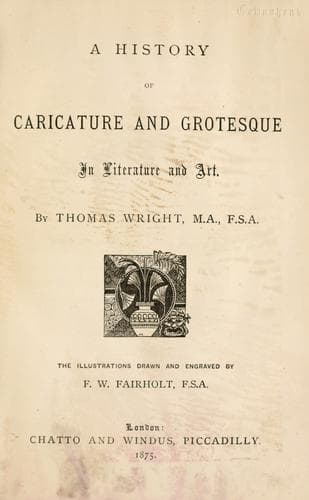
A History of Caricature and Grotesque in Literature and ArtWright, Thomas
History
A History of Caricature and Grotesque in Literature and Art
Wright, Thomas
Caricature -- History
of different incidents, selected from the less moral tales of the old
story-tellers as they appear in the "Decameron" of Boccaccio, among
which that of the ignorant and uneducated young wife, similar to the
plot of Wycherley's "Country Wife," is again introduced.
The corruption of morals had become so great, that when women took
up the pen, they exceeded in licentiousness even the other sex, as
was the case with Mrs. Behn. Aphra Behn is understood to have been
born at Canterbury, but to have passed some part of her youth in the
colony of Surinam, of which her father was governor. She evidently
possessed a disposition for intrigue, and she was employed by the
English government, a few years after the Restoration, as a political
spy at Antwerp. She subsequently settled in London, and gained a living
by her pen, which was very prolific in novels, poems, and plays. It
would be difficult to point out in any other works such scenes of
open profligacy as those presented in Mrs. Behn's two comedies of
"Sir Patient Fancy" and "The City Heiress, or Sir Timothy Treat-all,"
which appeared in 1678 and 1681. Concealment of the slightest kind is
avoided, and even that which cannot be exposed to view, is tolerably
broadly described.
It appears that the performance of the "London Cuckolds" had been the
cause of some scandal, and there were, even among play-goers, some who
took offence at such outrages on the ordinary feelings of modesty.
The excess of the evil had begun to produce a reaction. Ravenscroft,
the author of that comedy, produced on the stage, in 1684, a comedy,
entitled "Dame Dobson, or the Cunning Woman," which was intended to be
a modest play, but it was unceremoniously "damned" by the audience.
The prologue to this new comedy intimates that the "London Cuckolds"
had pleased the town and diverted the court, but that some "squeamish
females" had taken offence at it, and that he had now written a "dull,
civill" play to make amends. They are addressed, therefore, in such
terms as these:--
_In you, chaste ladies, then we hope to-day,
This is the poet's recantation play.
Come often to 't, that he at length may see
'Tis more than a pretended modesty.
Stick by him now, for if he finds you falter,
He quickly will his way of writing alter;
And every play shall send you blushing home,
For, though you rail, yet then we're sure you'll come._
And it is further intimated,--
_A naughty play was never counted dull--
Nor modest comedy e'er pleased you much._
Public-domain text, read in full here on John Shaqi.
Reviews
Reviews
No reviews yet
Be the first to share your thoughts on this work.
Elsewhere in the archive
Join the Discussion
Join the discussion
Sign in to leave a comment or review.
Sign InorCreate an account