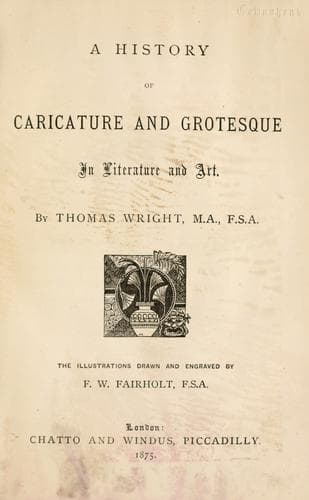
A History of Caricature and Grotesque in Literature and ArtWright, Thomas
History
A History of Caricature and Grotesque in Literature and Art
Wright, Thomas
Caricature -- History
"I remember," says Colley Cibber in his "Apology," looking back to
these times, "I remember the ladies were then observed to be decently
afraid of venturing bare-faced to a new comedy, till they had been
assured they might do it without the risk of an insult to their
modesty; or if their curiosity were too strong for their patience,
they took care at least to save appearances, and rarely came upon the
first days of acting but in masks (then daily worn, and admitted in the
pit, the side boxes, and gallery), which custom, however, had so many
ill consequences attending it, that it has been abolished these many
years." According to the _Spectator_, ladies began now to desert the
theatre when comedies were brought out, except those who "never miss
the first day of a new play, lest it should prove too luscious to admit
of their going with any countenance to the second."
In the midst of this abuse, there suddenly appeared a book which
created at the time a great sensation. The comedies of the latter half
of the seventeenth century were not only indecent, but they were filled
with profane language, and contained scenes in which religion itself
was treated with contempt. At that time there lived a divine of the
Church of England, celebrated for his Jacobitism--for I am now speaking
of the reign of king William--for his talents as a controversial
writer, and for his zeal in any cause which he undertook. This was
Jeremy Collier, the author of several books of some merit, which are
seldom read now, and who suffered for his zeal in the cause of king
James, and for his refusal to take the oath of allegiance to king
William. In the year 1698 Collier published his "Short View of the
Immorality and Profaneness of the English stage," in which he boldly
attacked the licentiousness of the English comedy. Perhaps Collier's
zeal carried him a little too far; but he had offended the wits, and
especially the dramatic poets, on all sides, and he was exposed to
attacks from all quarters, in which Dryden himself took an active part.
Collier showed himself fully capable of dealing with his opponents, and
the controversy had the effect of calling attention to the immoralities
of the stage, and certainly contributed much towards reforming them.
They were become much less frequent and less gross at the opening of
the eighteenth century.
Public-domain text, read in full here on John Shaqi.
Reviews
Reviews
No reviews yet
Be the first to share your thoughts on this work.
Elsewhere in the archive
Join the Discussion
Join the discussion
Sign in to leave a comment or review.
Sign InorCreate an account