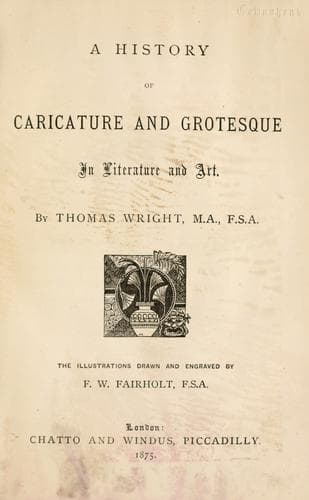
A History of Caricature and Grotesque in Literature and ArtWright, Thomas
History
A History of Caricature and Grotesque in Literature and Art
Wright, Thomas
Caricature -- History
To Samuel Foote, born in 1722, we owe the last change in the form and
character of English comedy. A man of infinite wit and humour, and
possessed of extraordinary talent as a mimic, Foote made mimicry the
principal instrument of his success on the stage. His plays are above
all light and amusing; he reduced the old comedy of five acts to three
acts, and his plots were usually simple, the dialogue full of wit and
humour; but their peculiar characteristic was their open boldness of
personal satire. It is entirely a comedy of his own. He sought to
direct his wit against all the vices of society, but this he did by
holding up to ridicule and scorn the individuals who had in some way
or other made themselves notorious by the practice of them. All his
principal characters were real characters, who were more or less known
to the public, and who were so perfectly mimicked on the stage in
their dress, gait, and speech, that it was impossible to mistake them.
Thus, in "The Devil upon Two Sticks," which is a general satire on the
low condition to which the practice of medicine had then fallen, the
personages introduced in it all represented quacks well known about the
town. "The Maid of Bath" dragged upon the stage scandals which were
then the talk of Bath society. The nabob of the comedy which bears
that title, had also his model in real life. "The Bankrupt" may be
considered as a general satire on the baseness of the newspaper press
of that day, which was made the means of propagating private scandals
and libellous accusations in order to extort money, yet the characters
introduced are said to have been all portraits from the life; and the
same statement is made with regard to the comedy of "The Author."
Public-domain text, read in full here on John Shaqi.
Reviews
Reviews
No reviews yet
Be the first to share your thoughts on this work.
Elsewhere in the archive
Join the Discussion
Join the discussion
Sign in to leave a comment or review.
Sign InorCreate an account