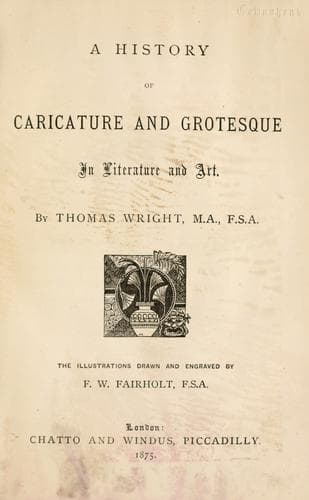
A History of Caricature and Grotesque in Literature and ArtWright, Thomas
History
A History of Caricature and Grotesque in Literature and Art
Wright, Thomas
Caricature -- History
Towards the end of the reign of king Charles II., the stage was more
largely employed as a political agent, and under his successor, James
II., the Puritans and the Whigs were constantly held up to scorn. After
the Revolution, the tables were turned, and the satire of the stage
was often aimed at Tories and Non-jurors. "The Non-juror," by Colley
Cibber, which appeared in 1717, at a very opportune moment, gained for
its author a pension and the office of poet-laureate. It was founded
upon the "Tartuffe" of Molière, for the English comedy writers borrowed
much from the foreign stage. A disguised priest, who passes under the
name of Dr. Wolf, and who had been engaged in the rebellion of 1715,
has insinuated himself into the household of a gentleman of fortune, of
not very strong judgment, Sir John Woodvil, whom, under the title of a
Non-juror, he has not only induced to become an abettor of rebels, but
he has persuaded him to disinherit his son, and he labours to seduce
his wife and to deceive his daughter. His baseness is exposed only just
soon enough to defeat his designs. Such a production as this could
not fail to give great offence to all the Jacobite party, of whatever
shade, who were then rather numerous in London, and Cibber assures us
that his reward was a considerable amount of adverse criticism in every
quarter where the Tory influence reached. His comedies were inferior in
brilliance of dialogue to those of the previous age, but the plots were
well imagined and conducted, and they are generally good acting plays.
Public-domain text, read in full here on John Shaqi.
Reviews
Reviews
No reviews yet
Be the first to share your thoughts on this work.
Elsewhere in the archive
Join the Discussion
Join the discussion
Sign in to leave a comment or review.
Sign InorCreate an account