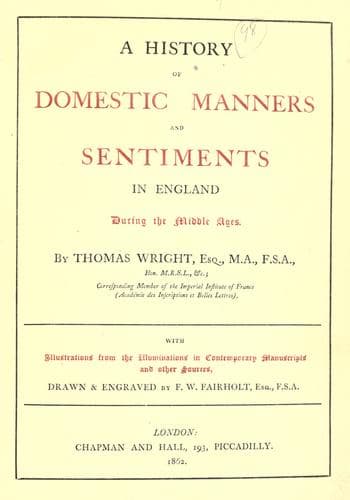
A History of Domestic Manners and Sentiments in England During the Middle AgesWright, Thomas
History
A History of Domestic Manners and Sentiments in England During the Middle Ages
Wright, Thomas
England -- Social life and customs -- 1066-1485
intimation of the fact that the minstrel was employed also in dark
deeds of poisoning. Still later on in the story of Fulk Fitz-Warine,
the hero himself goes to a tournament in France in disguise, and John
de Raunpaygne resumes his old character of a jougleur.” “John,” says
the narrative, “was very richly attired, and well mounted, and he had
a very rich tabor, and he struck the tabor at the entry to the lifts,
that the hills and valleys rebounded, and the horses became joyful.”
All these anecdotes reveal to us minstrels who were perfectly free, and
wandered from place to place at will; but there were others who were
retained by and in the regular employ of individuals. The king had his
minstrels, and so most of the barons had their household minstrels. In
one of the mediæval Latin stories, current in this country probably as
early as the thirteenth century, we are told that a jougleur (_mimus_
he is called in the Latin, a word used at this time as synonymous with
_joculator_) presented himself at the gate of a certain lord to enter
the hall and eat (for the table in those days was rarely refused to
a minstrel), but he was stopped by the porter, who asked him to what
lord he was attached, evidently thinking, as was thought some three
centuries later, that the treatment merited by the servant depended on
the quality of the master. The minstrel replied that his master was
God. When the porter communicated this response to his churlish lord,
or equally churlish steward, they replied that if he had no other
lord, he should not be admitted there. When the jougleur heard this,
he said that he was the devil’s own servant; whereupon he was received
joyfully, “because he was a good fellow” (_quia bonus socius erat_).
The records of the thirteenth and fourteenth centuries contain many
entries of payments to the king’s minstrels, and the names of some of
them are preserved. On great festivals at the king’s court, minstrels
came to seek employment from every part of the world which acknowledged
the reign of feudalism. Four hundred and twenty-six minstrels were
present at the marriage festivities of the princess Margaret, daughter
of Edward I.; and several hundred played before the same monarch at
the Whitsuntide of 1306. This affluence of minstrels gave rise to the
practice of building a large music-gallery at one end of the mediæval
hall, which seems to have been introduced in the fourteenth century. At
this time minstrels were sometimes employed for very singular purposes,
such as for soothing the king when undergoing a disagreeable operation.
We learn from the wardrobe accounts that, in the twenty-fifth year of
the reign of Edward I. (A.D. 1297) twenty shillings, or about
fifteen pounds in modern money, was given to the minstrel of Sir John
Maltravers as a reward for performing before the king while he was bled.
Public-domain text, read in full here on John Shaqi.
Reviews
Reviews
No reviews yet
Be the first to share your thoughts on this work.
Elsewhere in the archive
Join the Discussion
Join the discussion
Sign in to leave a comment or review.
Sign InorCreate an account