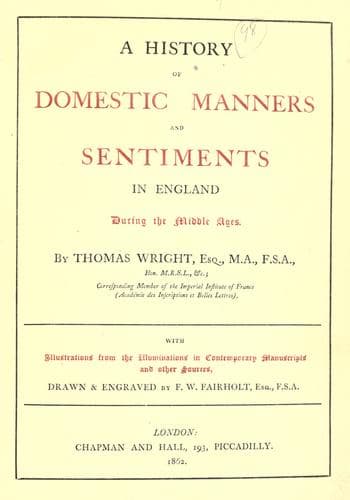
A History of Domestic Manners and Sentiments in England During the Middle AgesWright, Thomas
History
A History of Domestic Manners and Sentiments in England During the Middle Ages
Wright, Thomas
England -- Social life and customs -- 1066-1485
The king’s minstrels, and those of the great lords, were very well
paid, but the great mass of the profession, who depended only on what
they obtained in gifts at each particular feast, which they recklessly
squandered away as soon as they got it, lived a hard as it was a
vagabond life. The king’s minstrels, in the fourteenth century in
England, received from sixpence to sevenpence halfpenny a day, that
is from seven shillings and sixpence to nine shillings and fourpence
halfpenny, during the whole year. On the other hand, Colin Muset, one
of the best of the French song-writers of the thirteenth century,
complains of the want of liberality shown to him by the great baron
before whom he had played on the viol in his hostel, and who had given
him nothing, not even his wages:--
_Sire quens, j’ai vielé_
_Devant vos en vostre ostel;_
_Si ne m’avez riens donné,_
_Ne mes gages acquiter._
And he laments that he is obliged to go home in poverty, because his
wife always received him ill when he returned to her with an empty
purse, whereas, when he carried back his _malle_ well stuffed, he was
covered with caresses by his whole family. The French poet Rutebeuf,
whose works have been collected and published by M. Jubinal, may be
considered as the type of the better class of minstrels at this period,
and he has become an object of especial interest to us in consequence
of the number of his shorter effusions which describe his own position
in life. The first piece in the collection has for its subject his own
poverty. He complains of being reduced to such distress, that he had
been obliged for some time to live upon the generosity of his friends;
that people no longer showed any liberality to poor minstrels; that
he was perishing with cold and hunger; and that he had no other bed
but the bare straw. In another poem, entitled Rutebeuf’s Marriage,
he informs us that his privations were made more painful by the
circumstance of his having a shrew for his wife. In a third he laments
over the loss of the sight of his right eye, and informs us that, among
other misfortunes, his wife had just been delivered of a child, and his
horse had broke its leg, so that, while he had no means of supporting a
nurse for the former, the latter accident had deprived him of the power
of going to any distance to exercise his minstrelsy craft. Rutebeuf
repeats his laments on his extreme poverty in several other pieces,
and they have an echo in those of other minstrels of his age. We find,
in fact, in the verse-writers of the latter half of the thirteenth
century, and in some of those of the fourteenth, a general complaint of
the neglect of the minstrels, and of the degeneracy of minstrelsy. In a
poem against the growing taste for the tabor, printed in M. Jubinal’s
volume, entitled “Jougleurs et Trouvères,” the low state into which the
minstrels’ art had fallen is ascribed to a growing love for instruments
Public-domain text, read in full here on John Shaqi.
Reviews
Reviews
No reviews yet
Be the first to share your thoughts on this work.
Elsewhere in the archive
Join the Discussion
Join the discussion
Sign in to leave a comment or review.
Sign InorCreate an account