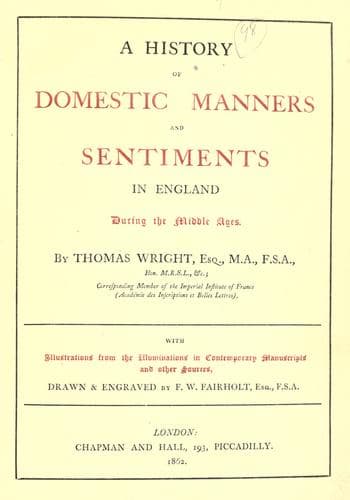
A History of Domestic Manners and Sentiments in England During the Middle AgesWright, Thomas
History
A History of Domestic Manners and Sentiments in England During the Middle Ages
Wright, Thomas
England -- Social life and customs -- 1066-1485
_Bleve_ (quickly) _to soper they dyght,_
_Both squiere and knyght;_
_They daunsed and revelide that nyght,_
_In hert were they blythe_.
In a fabliau published by Barbazan, on the arrival in a nobleman’s
castle of a knight who is treated with especial courtesy, the knights
and ladies dance after supper, and then, at bed-time, they conduct the
visitor into his bed-chamber, and drink with him there before they
leave him:--
_Après mengier, chascuns comence_
_De faire caroles et dance,_
Tant qu’il fu houre de couchier;_
_Puis anmainment le chevalier_
_En sa chambre où fait fu son lit,_
_Et là burent par grant delit;_
_Puis prinrent congié._
Fruit was usually eaten after supper. In a fabliau of the thirteenth
century, a noble visitor having been received in the house of a knight,
they go immediately to supper. “After they had done eating, they
enjoyed themselves in conversation, and then they had fruit,” and it
was only after this that they washed--
_Après mengier se sont deduit_
_De paroles, puis si ont fruit._
In the lay of the “Chevalier à l’Espée,” Sir Gauwain takes, instead of
supper, fruit and wine before he goes to bed.
The custom of keeping early hours still prevailed, and is very
frequently alluded to. People are generally described as rising with
the sun. Such was the case with the king, in the romance of “Parise la
Duchesse”--
_Landemain par matin, quand solaus fu levez,_
_Se leva li rois Hugues._
--Parise, ed. P. Paris, p. 219.
Public-domain text, read in full here on John Shaqi.
Reviews
Reviews
No reviews yet
Be the first to share your thoughts on this work.
Elsewhere in the archive
Join the Discussion
Join the discussion
Sign in to leave a comment or review.
Sign InorCreate an account