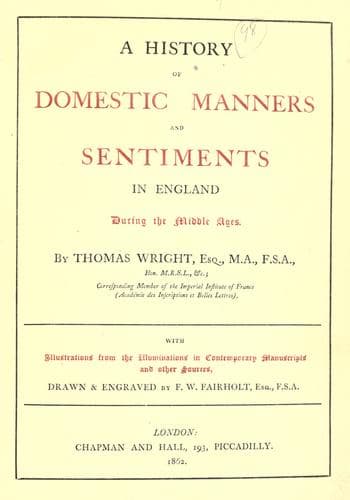
A History of Domestic Manners and Sentiments in England During the Middle AgesWright, Thomas
History
A History of Domestic Manners and Sentiments in England During the Middle Ages
Wright, Thomas
England -- Social life and customs -- 1066-1485
It was the custom, after rising, to attend service either in the
church or in the private chapel. In the history of Fulke Fitz-Warine,
Jose de Dynan, in his castle of Ludlow, rose early in the morning,
heard service in the chapel, after which he mounted to the top of the
loftiest tower, to take a view of the country around, then descended
and “caused the horn to be sounded for washing.” This was no doubt
the signal for the household to assemble for breakfast. In Chaucer’s
“Squyeres Tale,” the king’s guests, after great feasting and carousing
at night, sleep till “prime large” in the morning, that is till six
o’clock, which is spoken of in a manner which evidently intimates
that they had considerably overslept themselves. The princess Canace
had left her bed long before, and was walking with her maidens in the
park. In the “Schipmannes Tale,” too, the lady rises very early in the
morning, and takes her walk in the garden. In the curious “Book” of the
Chevalier de la Tour Landry, we are told of a very pious dame whom he
knew, whose daily life was as follows:--She rose early in the morning,
had two friars and two or three chaplains in attendance to chant matins
while she was rising; as soon as she left her chamber she went to
her chapel, and remained in devotion in her oratory while they said
matins and one mass, and then she went and dressed and arrayed herself,
after which she went to recreate herself in the garden or about the
house; she then attended divine service again, and after it went to
dinner; and during the afternoon she visited the sick, and in due time
supped, and after supper she called her _maître d’hôtel_, and made her
household arrangements for the following day.
The hour of breakfast is very uncertain, and appears not to have been
fixed. The hour of dinner was, as already stated, nine o’clock in the
morning, or sometimes ten. In the lay of the “Mantel Mautaillé,” king
Arthur is introduced on a grand festival day refusing, according to
his custom, to begin the dinner till some “adventure” occurs, and the
guests wait till near “nonne,” when the grand seneschal, Sir Keux,
takes upon himself to expostulate, and represents that dinner had been
ready a long time (_pieçà_). _Nonne_ is here probably meant for midday,
or noon. The queen was in her chamber, greatly distressed at having to
wait so long for dinner. The regular hour of supper appears to have
been five o’clock in the afternoon, but when private it seems not to
have been fixed to any particular hour. In summer, at least, people
appear usually to have gone to bed when darkness approached; and this
was the time at which guests ordinarily took their leave. Thus, at
January’s wedding-feast, in Chaucer, we are told that--
Public-domain text, read in full here on John Shaqi.
Reviews
Reviews
No reviews yet
Be the first to share your thoughts on this work.
Elsewhere in the archive
Join the Discussion
Join the discussion
Sign in to leave a comment or review.
Sign InorCreate an account