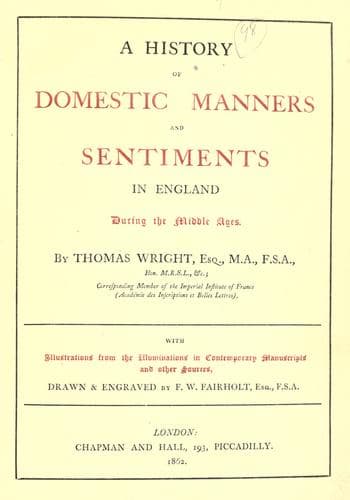
A History of Domestic Manners and Sentiments in England During the Middle AgesWright, Thomas
History
A History of Domestic Manners and Sentiments in England During the Middle Ages
Wright, Thomas
England -- Social life and customs -- 1066-1485
_Night, with his mantel, that is dark and rude,_
_Gan oversprede themesperie aboute;_
_For which departed is the lusti route_
_Fro January, with thank on every side,_
_Hoom to her houses lustily thay ryde._
--Cant. Tales, l. 9672.
We must not forget that these remarks apply to the seasons of the year
when days were long, for the scenes of most of these romances and tales
are laid in the spring and summer months, and especially in May. We
have much less information on the domestic relations during winter.
[Illustration: _No. 176. A Supper._]
One reason for keeping early hours was that candles and lamps were too
expensive to be used in profusion by people in general. Various methods
of giving artificial light at night are mentioned, most of which seem
to have been considered more or less as luxuries. At grand festivals
the light was often given by men holding torches. In general, candles
were used at supper. The accompanying cut (No. 176), taken from the
manuscript of the St. Graal already mentioned, represents a person
supping by candlelight. In the fabliau of “La Borgoise d’Orliens,” a
lady, receiving her lover into her chamber, spreads a table for him,
and lights a great wax candle (_grosse chandoile de cire_).
Lighting in the middle ages was, indeed, effected, in a manner more
or less refined, by means of torches, lamps, and candles. The candle,
which was the most portable of them all, was employed in small and
private evening parties; and, from an early period, it was used in the
bed-chamber. For the table very handsome candlesticks were made, which
were employed by people of rank, and wax-candles (_cierges_) were used
on them. They were formed with an upright spike (_broche_), on which
the candle was stuck, not, as now, placed in a socket. Thus, in a scene
in one of the fabliaux printed by Barbazan, a good _bourgeois_ has on
his supper-table two candlesticks of silver, “very fair and handsome,”
with wax-candles--
_Desor la table ot deus broissins,_
_Où il avoit cierges, d’argent,_
_Molt estoient bel et gent._
--Barbazan, vol. iv. p. 184.
So in the romance of “La Violette,” when the count Lisiart arrives at
the castle of duke Gerart, on the approach of bedtime, two men-servants
make their appearance, each carrying a lighted _cierge_, or wax-candle,
and thus they lead him to his chamber--
_Atant lor vinrent doi sergant,_
_Chascuns tenoit j. cerge ardant;_
_Le conte menerent couchier._
--La Violette, p. 30.
Public-domain text, read in full here on John Shaqi.
Reviews
Reviews
No reviews yet
Be the first to share your thoughts on this work.
Elsewhere in the archive
Join the Discussion
Join the discussion
Sign in to leave a comment or review.
Sign InorCreate an account