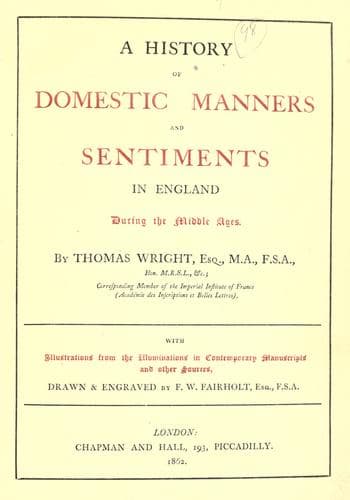
A History of Domestic Manners and Sentiments in England During the Middle AgesWright, Thomas
History
A History of Domestic Manners and Sentiments in England During the Middle Ages
Wright, Thomas
England -- Social life and customs -- 1066-1485
In the midst of these familiarities, Guillaume made his declaration of
love, and was rejected, but his pursuit was ultimately successful. In
another fabliau of the thirteenth century, that of “Gautier d’Aupais,”
it is the daughter of his lord and lady with whom the young “damoisel”
falls in love, and he takes the opportunity one morning, while the two
latter are at church, to pay a visit to the young lady in her chamber.
Although in bed on account of illness--and it has been already stated
how people went to bed without any clothing--the lady is not surprised
by Gautier’s visit, but invites him to sit on her bed, and tell her
something to amuse her, and he finds the opportunity of making his
love with more success than the hero of the other tale. In the same
manner, the ladies are continually described as visiting the gentlemen
in their chambers, both by day and by night. In “Blonde of Oxford,” a
fashionable romance composed for the entertainment of the best society,
Blonde thus leaves her bed, throwing only a mantle over her person,
to pass whole nights with Jean of Dammartin, and their interviews are
described in language which would not be allowed in any respectable
book at the present day. The chevalier de la Tour-Landry, in his moral
instructions to his daughters, tells them a story to illustrate the
ill results of a quarrelsome temper. There was a young lady, he says,
the daughter of “a very gentle knight,” who quarrelled at the game of
tables with a gentleman who had no better temper than herself, and who,
provoked by the irritating language she used towards him, told her
that she was known to be in the habit of going by night into the men’s
chambers, and kissing and embracing them in their beds without candle;
and this is told, not in reproof of conduct which was unusually bad,
but to show that people who speak ill of others run the risk of having
their own failings exposed. Examples of this intercourse of persons of
different sexes in their chambers, and of the results which frequently
followed, from the mediæval romances and stories, might be multiplied
to almost any extent.
Public-domain text, read in full here on John Shaqi.
Reviews
Reviews
No reviews yet
Be the first to share your thoughts on this work.
Elsewhere in the archive
Join the Discussion
Join the discussion
Sign in to leave a comment or review.
Sign InorCreate an account