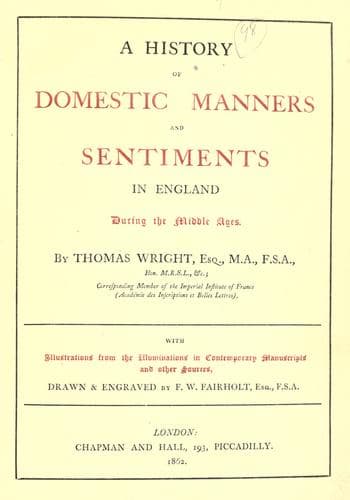
A History of Domestic Manners and Sentiments in England During the Middle AgesWright, Thomas
History
A History of Domestic Manners and Sentiments in England During the Middle Ages
Wright, Thomas
England -- Social life and customs -- 1066-1485
In these stories, the ladies in general show no great degree of
delicacy, but, on the contrary, they are commonly very forward. It is
usual with them to fall in love with the other sex, and, so far from
attempting to conceal their passion, they often become suitors, and
make their advances with more warmth and less delicacy than is shown
by the gentlemen in a similar position. Not only are their manners
dissolute, but their language and conversation are loose beyond
anything that those who have not read these interesting records of
mediæval life can easily conceive, which was a common failing with both
sexes. The author of the “Ménagier de Paris” (ii. 60), in recommending
to his daughters some degree of modesty on this point, makes use of
words which his modern editor, although printing a text in obsolete
language, thought it advisable to suppress. It might be argued that the
use of such language is evidence rather of the coarseness than of the
immorality of the age, but, unfortunately, the latter interpretation is
supported by the whole tenor of contemporary literature and anecdote,
which leave no doubt that mediæval society was profoundly immoral and
licentious.
On the other hand, the gallantry and refinement of feeling which the
gentleman is made to show towards the other sex, is but a conventional
politeness; for the ladies are too often treated with great brutality.
Men beating their wives, and even women with whom they quarrel who
are not their wives, is a common incident in the tales and romances.
The chevalier de la Tour-Landry tells his daughters the story of a
woman who was in the habit of contradicting her husband in public,
and replying to him ungraciously, for which, after the husband had
expostulated in vain, he one day raised his fist and knocked her down,
and kicked her in the face while she was down, and broke her nose.
“And so,” says the knightly instructor, “she was disfigured for life,
and thus, through her ill behaviour and bad temper, she had her nose
spoiled, which was a great misfortune to her. It would have been better
for her to be silent and submissive, for it is only right that words
of authority should belong to her lord, and the wife’s honour requires
that she should listen in peace and obedience.” The good “chevalier”
makes no remark on the husband’s brutality, as though it were by no
means an unusual occurrence.
Public-domain text, read in full here on John Shaqi.
Reviews
Reviews
No reviews yet
Be the first to share your thoughts on this work.
Elsewhere in the archive
Join the Discussion
Join the discussion
Sign in to leave a comment or review.
Sign InorCreate an account