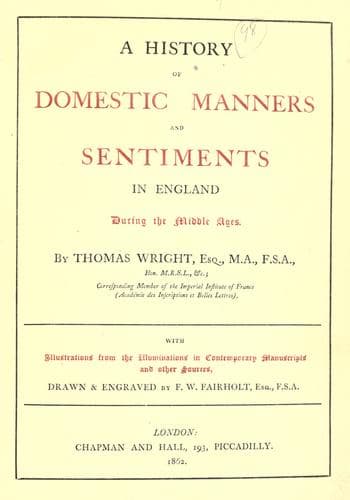
A History of Domestic Manners and Sentiments in England During the Middle AgesWright, Thomas
History
A History of Domestic Manners and Sentiments in England During the Middle Ages
Wright, Thomas
England -- Social life and customs -- 1066-1485
and feed all the “chamber animals,” such as pet dogs, cage birds, &c.
The next thing to be done was to portion out to each servant her or
his work for the day. At midday the servants were to have their first
meal, when they were to be fed plentifully, but “only of one meat, and
not of several or of any delicacies; and give them one only kind of
drink, nourishing but not heady, whether wine or other; and admonish
them to eat heartily, and to drink well and plentifully, for it is
right that they should eat all at once, without sitting too long, and
at one breath, without reposing on their meal, or halting, or leaning
with their elbows on the table; and as soon as they begin to talk, or
to rest on their elbows, make them rise, and remove the table.” After
their “second labour,” and on feast-days, the servants were to have
another, apparently a lighter, repast, and lastly, in the evening (_au
vespre_), they were to have another abundant meal, like their dinner,
and then, “if the season required it,” they were to be “warmed and made
comfortable.” The lady of the house was then, by herself or a deputy on
whom she could depend, to see that the house was closed, and to take
charge of the keys, that nobody could go out or come in; and then to
have all the fires carefully “covered,” and send all the servants to
bed, taking care that they put out their candles properly, to prevent
the risk of fire. In the English poem of the “Seven Sages,” printed by
Weber, the emperor is described as going to his chamber, after the time
of locking windows and gates--
_Whan men leke windowe and gate,_
_Themparour com to chambre late._
--Weber, iii. 60.
And it appears from a tale in the same collection, that the doors and
windows were unlocked at daybreak--
_Tho_ (when) _the day dawen gan,_
_Awai stal the yonge man;_
_Men unlek dore and windowe_.
--Ib., p. 87.
Public-domain text, read in full here on John Shaqi.
Reviews
Reviews
No reviews yet
Be the first to share your thoughts on this work.
Elsewhere in the archive
Join the Discussion
Join the discussion
Sign in to leave a comment or review.
Sign InorCreate an account