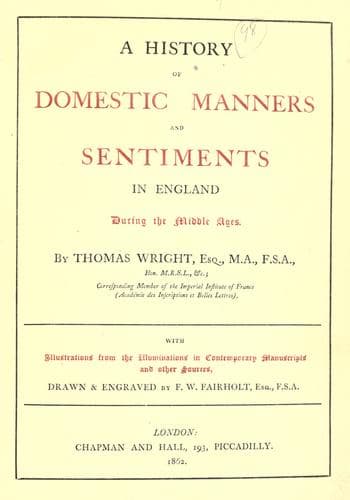
A History of Domestic Manners and Sentiments in England During the Middle AgesWright, Thomas
History
A History of Domestic Manners and Sentiments in England During the Middle Ages
Wright, Thomas
England -- Social life and customs -- 1066-1485
“In eating, you must avoid much laughing or talking. If you
eat with another (_i. e._, in the same plate, or of the same mess),
turn the nicest bits to him, and do not go picking out the finest and
largest for yourself, which is not courteous. Moreover, no one should
eat greedily a choice bit which is too large or too hot, for fear of
choking or burning herself.... Each time you drink, wipe your mouth
well, that no grease may go into the wine, which is very unpleasant
to the person who drinks after you. But when you wipe your mouth for
drinking, do not wipe your eyes or nose with the table-cloth, and avoid
spilling from your mouth, or greasing your hands too much.” The lady
is further, and particularly, recommended not to utter falsehoods.
The remainder of the poem consist of directions in making love and
receiving the addresses of suitors. The “Book” of the chevalier de la
Tour-Landry contains instructions for young ladies, in substance very
much like these, but illustrated by stories and examples.
The chamber-maidens also went abroad, like the young sons of gentlemen;
but female servants who came as strangers appear not in general to
have been well regarded, and they probably were, or were considered
as, a lower class. The circumstance of their having left the country
where they were known, was looked upon as _prima facie_ evidence that
their conduct had brought them into discredit there. The author of
the “Ménagier de Paris” advises his daughter never to take any such
_chambrières_, without having first sent to make strict inquiries about
them in the parts from whence they came. This same early writer on
domestic economy divides the servants, who, in a large household, were
very numerous, into three classes: those who were employed on a sudden,
and only for a certain work, with regard to whom the principal caution
given is to bargain with them for the price of their labour before
they begin; those who were employed for a certain time in a particular
description of work, as tailors, shoemakers, butchers, and others,
who always came to work in the house on materials belonging to the
master of the house, or harvest-men, &c., in the country; and domestic
servants who were hired by the year. These latter were expected to pay
an absolute passive obedience to the lord and lady of the household,
and to those set in authority by them. The lady of the house had the
especial charge of the female servants, and the “Ménagier” contains
rather minute directions as to her housekeeping duties. She was to
require of the maid-servants, “that early in the morning the entrance
to your hostel, that is, the hall, and the other places by which
people enter and stop in the hostel to converse, be swept and made
clean, and that the footstools and covers of the benches and forms be
dusted and shaken, and after this that the other chambers be in like
manner cleaned and arranged for the day.” They were next to attend to
Public-domain text, read in full here on John Shaqi.
Reviews
Reviews
No reviews yet
Be the first to share your thoughts on this work.
Elsewhere in the archive
Join the Discussion
Join the discussion
Sign in to leave a comment or review.
Sign InorCreate an account