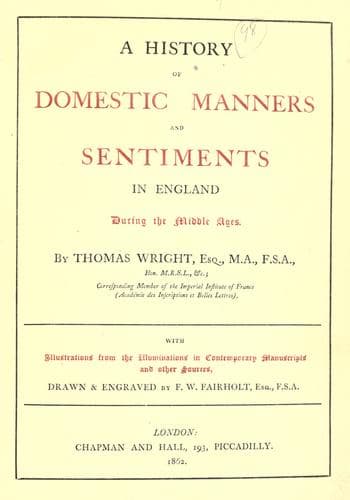
A History of Domestic Manners and Sentiments in England During the Middle AgesWright, Thomas
History
A History of Domestic Manners and Sentiments in England During the Middle Ages
Wright, Thomas
England -- Social life and customs -- 1066-1485
The burghers also cherished a number of servants and followers in their
household, or _mesnie_. In the fabliau of “La Borgoise d’Orliens,” the
mesnie of the burgher, who is not represented as a person of wealth or
distinction, consists of two nephews, a lad who carried water, three
chamber-maidens, a niece, two pautoniers, and a ribald, and these were
all harboured in the hall. The pautonier was only another name for the
ribald, or perhaps it was a sub-class or division of the infamous class
who lived parasitically upon the society of the middle ages. Even the
ordinary agriculturist had his _mesnie_.
What I have said of the great dissoluteness and immorality of the
aristocratic class applies more especially to the households of the
greater barons, though the same spirit must have spread itself far
through the whole class. The aristocratic class was itself divided into
two classes, or rather two ranks,--the great barons, and the knights
and lesser landholders, and the division between these two classes
became wider, and the latter more absolutely independent, as the power
of feudalism declined. These latter were the origin of that class which
in more modern times has been known by the title of the old country
gentleman. As far as we can judge from what we know of them, I am led
to think that this class was the most truly dignified, and in general
the most moral, portion of mediæval society. There is abundant evidence
that the tone of morality in the burgher and agricultural classes
was not high; and the whole tenor of mediæval popular and historical
literature can leave no doubt on our minds that in the middle ages the
clergy were the great corruptors of domestic virtue among both these
classes. The character of the women, as described in the old satirists
and story-tellers, as well as in records of a still more strictly
truthful character, was very low, and, in the towns especially, they
are described as spending much of their time in the taverns, drinking
and gossiping. Of course there were everywhere--and, it is to be
trusted, not a few--bright exceptions to this general character.
CHAPTER XIII.
OCCUPATIONS OUT OF DOORS.--THE PLEASURE-GARDEN.--THE LOVE OF
FLOWERS, AND THE FASHION OF MAKING GARLANDS.--FORMALITIES OF THE
PROMENADE.--GARDENING IN THE MIDDLE AGES.
Public-domain text, read in full here on John Shaqi.
Reviews
Reviews
No reviews yet
Be the first to share your thoughts on this work.
Elsewhere in the archive
Join the Discussion
Join the discussion
Sign in to leave a comment or review.
Sign InorCreate an account