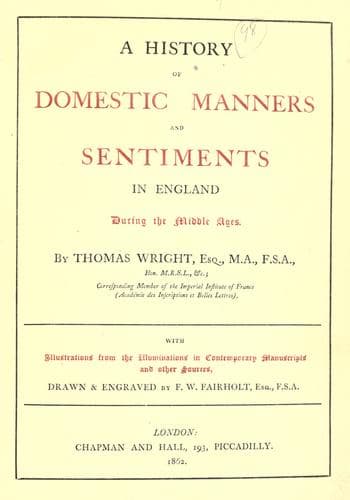
A History of Domestic Manners and Sentiments in England During the Middle AgesWright, Thomas
History
A History of Domestic Manners and Sentiments in England During the Middle Ages
Wright, Thomas
England -- Social life and customs -- 1066-1485
Humboldt, in his “Cosmos,” has dwelt on the taste for the beauties of
nature which has prevailed among various peoples, and at different
periods of the world’s history, but he appears to me to have by no
means appreciated or done justice to the force of this sentiment among
our forefathers in the middle ages, and, perhaps I may say, especially
in England. In our ancient popular poetry, the mention of the season of
the year at which an event happens generally draws from the poet some
allusion to the charms of nature peculiar to it, to the sweetness of
the flowers, the richness of the fruit, or the harmony of the song of
birds. In some of the early romances, each new division of the poem is
introduced by an allusion of this kind. Thus, at the opening of what
the editor calls the first chapter of the second part of the romance of
“Richard Cœur de Lion,” the poet tells us how it--
_Merye is in the tyme of May,_
_Whenne foulis synge in her lay;_
_Floures on appyl-trees and perye_ (pear-tree);
_Smale foules synge merye._
_Ladyes strowe here boures_ (chambers)
_With rede roses and lylye flowres;_
_Gret joye is in frith_ (grove) _and lake_.
--Weber, ii. 149.
Such interruptions of the narrative are frequent in the long romance of
“Alexander” (Alexander the Great), and are always expressive. Thus, on
one occasion the poet tells us, abruptly enough, how--
_Whan corn ripeth in every steode_ (place),
_Mury_ (pleasant) _it is in feld and hyde_ (meadow).
--Ibid., i. 24.
And again, introduced equally abruptly, we are informed--
_In tyme of hervest mery it is ynough;_
_Peres and apples hongeth on bough._
_The hayward bloweth mery his horne;_
_In everyche_ (every) _felde ripe is corne;_
_The grapes hongen on the vyne;_
_Swete is trewe love and fyne_.
--Weber, p. 238.
When, indeed, we consider the confined and dark character of most of
the apartments of the feudal dwelling, we cannot be surprised if our
mediæval forefathers loved the recreations which brought them into
the open air. Castles and country mansions had always their gardens
and pleasure-grounds, which were much frequented by all the different
branches of the household. The readers of Chaucer will remember the
description of the “noble” knight January--
_Amonges other of his honest thinges,_
_He had a gardyn walled al with stoon,_
_So fair a gardyn wot I no wher noon._
It is implied, at least, that this garden was extensive, and--
_This noble knight, this January the olde,_
_Such deynté hath in it to walk and playe,_
_That he wold no wight suffre bere the keye,_
_Save he himself._
--CHAUCER, The Marchaundes Tale.
So, in the curious popular collection of mediæval stories, entitled the
“Seven Sages,” we are told of a rich burgess who
Public-domain text, read in full here on John Shaqi.
Reviews
Reviews
No reviews yet
Be the first to share your thoughts on this work.
Elsewhere in the archive
Join the Discussion
Join the discussion
Sign in to leave a comment or review.
Sign InorCreate an account