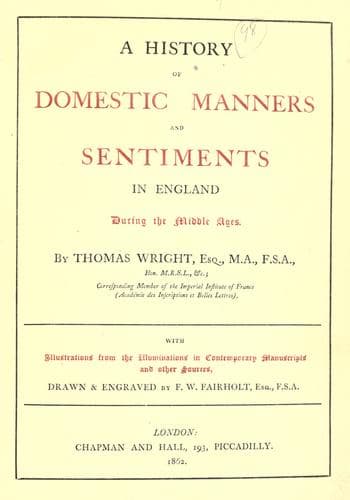
A History of Domestic Manners and Sentiments in England During the Middle Ages — John Shaqi
A History of Domestic Manners and Sentiments in England During the Middle AgesWright, Thomas
History
A History of Domestic Manners and Sentiments in England During the Middle Ages
Wright, Thomas
England -- Social life and customs -- 1066-1485
claim for my book at least the merit of being the result of original
research. It is not a compilation from writers who have written on the
subject before.
There are at least two ways of arranging a work like this. I might have
taken each particular division of the subject, one after the other,
and traced it separately through the period of history which this
volume embraces; or the whole subject might be divided into historical
periods, in each of which all the different phases of social history
for that period are included. Each of these plans has its advantages
and defects. In the first, the reader would perhaps obtain a clearer
notion of the history of any particular division of the subject, as
of the history of the table and of diet, or of games and amusements,
or the like, but at the same time it would have required a certain
effort of comparison and study to arrive at a clear view of the
general question at a particular period. The second furnishes this
general view, but entails a certain amount of what might almost be
called repetition. I have chosen the latter plan, because I think this
repetition will be found to be only apparent, and it seems to me the
best arrangement for a popular book.
The division of periods, too, is, on the whole, natural, and not
arbitrary. During the Anglo-Saxon period, the social system, however
developed or modified from time to time, was strictly that of our own
Anglo-Saxon forefathers, and was the undoubted groundwork of our own.
The Norman conquest brought in foreign social manners and sentiments
totally different from those of the Anglo-Saxons, which for a time
predominated, but became gradually incorporated with the Anglo-Saxon
manners and spirit, until, towards the end of the twelfth century,
they formed the English of the middle ages. The Anglo-Norman period,
therefore, may be considered as an age of transition--it may perhaps
be described as that of the struggle between the spirit of Anglo-Saxon
society and feudalism. The thirteenth and fourteenth centuries may
be considered in regard to society as the English middle ages--the
age of feudalism in its English form--and therefore hold properly the
largest space in this volume. The fifteenth century forms again a
distinct period in the history of society--it was that of the decline
and breaking up of feudalism, the close of the middle ages. At the
Reformation, we come to a new transition period--the transition from
mediæval to modern society. This, for several reasons, I regard rather
as a conclusion, than as an integral part, of the history contained in
the following pages, and I therefore give only a light sketch of it,
noticing some of its prominent characteristics. The materials, at this
late period, become so extensive, and so full of interest, that its
history admits of several divisions, each of which is sufficient for
an important book, and I leave them to future researches. One period,
Public-domain text, read in full here on John Shaqi.
Reviews
Reviews
No reviews yet
Be the first to share your thoughts on this work.
Join the Discussion
Join the discussion
Sign in to leave a comment or review.
Sign InorCreate an account