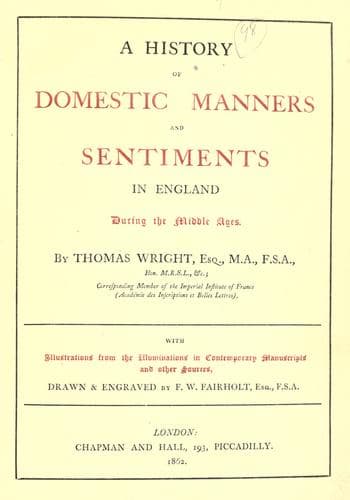
A History of Domestic Manners and Sentiments in England During the Middle AgesWright, Thomas
History
A History of Domestic Manners and Sentiments in England During the Middle Ages
Wright, Thomas
England -- Social life and customs -- 1066-1485
_Hadde, bihinden his paleys,_
_A fair gardin of nobleys,_
_Ful of appel-tres, and als_ (also) _of pirie_ (pear-trees);
_Foules songe therinne murie._
_Amideward that gardyn fre,_
_So wax_ (grew) _a pinnote-tre,_
_That hadde fair bowes and frut;_
_Ther under was al his dedut_ (pleasure).
_He made ther-under a grene bench,_
_And drank ther under many a sschench_ (cupful).
--Weber, iii. 23.
And again, in the same collection of stories, a prudent mother,
counselling her daughter, tells her--
_Daughter, thi loverd_ (lord) _hath a gardin,_
_A wel fair ympe_ (young tree) _is tharin;
A fair harbeth_ (arbour) _hit overspredeth,_
_Alle his solas therinne he ledeth_.
--Weber, iii. 69.
In Chaucer’s “Frankeleynes Tale,” when the lady Dorigen was in want of
amusement to make her forget the absence of her husband, her friends,
finding that the sea-shore was not sufficiently gay,--
_Schope hem for to pleien somwhere elles,_
_They leden hire by rivers and by welles,_
_And eke in other places delitables;_
_They dauncen, and they pley at ches and tables._
_So on a day, right in the morwe tide,_
_Unto a gardeyn that was ther beside,_
_In which that they had made her ordinance_
_Of vitaile, and of other purveance,_
_They gon and plaie hem al the longe day:_
_And this was on the sixte morwe of May,_
_Which May had painted with his softe schoures_
_This gardeyn ful of leves and of floures:_
_And craft of mannes hond so curiously_
_Arrayed had this gardeyn of suche pris_
_As if it were the verray paradis._
* * * * *
_And after dinner gan thay to daunce
_And singe also; sauf Dorigen alone._
An important incident in the story here occurs, after which--
_Tho_ (then) _come hir other frendes many on,_
_And in the alleyes romed up and down,_
_And nothing wist of this conclusioun,_
_But sodeynly began to revel newe,_
_Til that the brighte sonne had lost his hewe_.
It would be easy to multiply such descriptions as the foregoing, but
we will only refer to the well-known one at the commencement of the
“Romance of the Rose,” where the carolling is described with more
minuteness than usual. There were employed minstrels, and “jogelours,”
and apparently even tumblers, which are thus described in Chaucer’s
English version:--
Public-domain text, read in full here on John Shaqi.
Reviews
Reviews
No reviews yet
Be the first to share your thoughts on this work.
Elsewhere in the archive
Join the Discussion
Join the discussion
Sign in to leave a comment or review.
Sign InorCreate an account