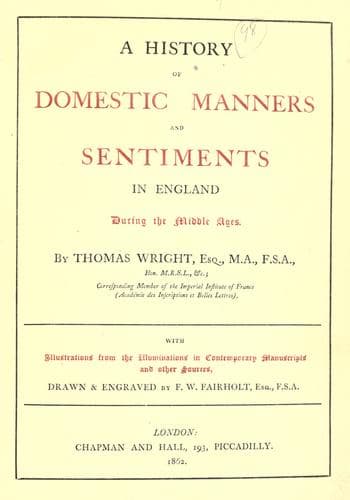
A History of Domestic Manners and Sentiments in England During the Middle AgesWright, Thomas
History
A History of Domestic Manners and Sentiments in England During the Middle Ages
Wright, Thomas
England -- Social life and customs -- 1066-1485
[Illustration: _No. 210. Ladies Riding._]
Travelling on horseback was now more common than at an earlier period,
and this was not unfrequently a subject of popular complaint. In
fact, men who rode on horseback considered themselves much above
the pedestrians; they often went in companies, and were generally
accompanied with grooms, and other riotous followers, who committed all
sorts of depredations and violence on the peasantry in their way. A
satirical song of the latter end of the reign of Edward I., represents
our Saviour as discouraging the practice of riding. “While God was on
earth,” says the writer, “and wandered wide, what was the reason he
would not ride? Because he would not have a groom to go by his side,
nor the grudging (or discontent) of any gadling to jaw or to chide:”--
_Whil God was on erthe_
_And wondrede wyde,_
_Whet wes the resoun_
_Why he nolde ryde?_
_For he nolde no groom_
_To go by hys syde,_
_Ne grucchyng of no gedelyng_
_To chaule ne to chyde._
[Illustration: _No. 211. An Abbot travelling._]
“Listen to me, horsemen,” continues this satirist, “and I will tell you
news--that ye shall hang, and be lodged in hell:”--
_Herkneth hideward, horsmen,_
_A tidyng ich ou telle,_
_That ye shulen hongen,_
_Ant herbarewen in helle!_
The clergy were great riders, and abbots and monks are not unfrequently
figured on horseback. Our cut No. 211 (from MS. Cotton, Nero, D. vii.)
represents an abbot riding, with a hat over his hood; he is giving his
benediction in return to the salute of some passing traveller.
[Illustration: _No. 212. A Knight and his Steed._]
The knight still carried his spear with him in travelling, as the
footman carried his staff. In our cut No. 212, from a manuscript of the
fourteenth century in the Bibliothèque Nationale in Paris (No. 6963),
the rider, though not armed, carries his spear with him. The saddle in
this instance is singularly and rather rudely formed. It was a great
point of vanity in the middle ages in England to hang the caparisons
of the horse with small bells, which made a jingling noise. In the
romance of “Richard Cœur de Lion” (Weber ii. 60), a messenger coming to
king Richard has no less than five hundred such bells suspended to his
horse--
_His trappys wer off tuely sylke,_
_With five hundred belles rygande._
And again, in the same romance (vol. ii. p. 223), we are told, in
speaking of the sultan of “Damas,” that his horse was well furnished in
this respect--
_Hys crouper heeng al fulle off belles,_
_And hys peytrel, and hys arsoun;_
_Three myle myghte men here the soun._
The bridle, however, was the part of the harness usually loaded with
bells, and, according to Chaucer, it was a vanity especially affected
by the monks; for the poet tells us of his monk, that--
Public-domain text, read in full here on John Shaqi.
Reviews
Reviews
No reviews yet
Be the first to share your thoughts on this work.
Elsewhere in the archive
Join the Discussion
Join the discussion
Sign in to leave a comment or review.
Sign InorCreate an account