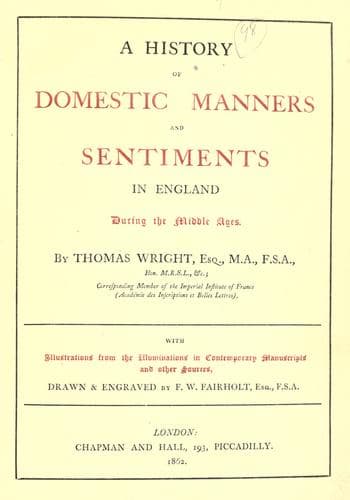
A History of Domestic Manners and Sentiments in England During the Middle AgesWright, Thomas
History
A History of Domestic Manners and Sentiments in England During the Middle Ages
Wright, Thomas
England -- Social life and customs -- 1066-1485
The drinking-horn was in common use among the Anglo-Saxons. It is seen
on the table or in the hands of the drinkers in more than one of our
cuts. In the will of one Saxon lady, two buffalo-horns are mentioned;
three horns worked with gold and silver are mentioned in one inventory;
and we find four horns enumerated among the effects of a monastic
house. The Mercian king Witlaf, with somewhat of the sentiment of the
lady Ethelgiva, gave to the abbey of Croyland the horn of his table,
“that the elder monks may drink from it on festivals, and in their
benedictions remember sometimes the soul of the donor.”
[Illustration: _No. 23. Articles of Value._]
The liquors drunk by the Saxons were chiefly ale and mead; the immense
quantity of honey that was then produced in this country, as we learn
from Domesday-book and other records, shows us how great must have
been the consumption of the latter article. Welsh ale is especially
spoken of. Wine was also in use, though it was an expensive article,
and was in a great measure restricted to persons above the common rank.
According to Alfric’s Colloquy, the merchant brought from foreign
countries wine and oil; and when the scholar is asked why he does not
drink wine, he says he is not rich enough to buy it, “and wine is not
the drink of children or fools, but of elders and wise men.” There
were, however, vineyards in England in the times of the Saxons, and
wine was made from them; but they were probably rare, and chiefly
attached to the monastic establishments. William of Malmesbury speaks
of a vineyard attached to his monastery, which was first planted at the
beginning of the eleventh century by a Greek monk who settled there,
and who spent all his time in cultivating it.
In their drinking, the Anglo-Saxons had various festive ceremonies,
one of which is made known to us by the popular story of the lady
Rowena and the British king. When the ale or wine was first served, the
drinkers pledged each other, with certain phrases of wishing health,
not much unlike the mode in which we still take wine with each other
at table, or as people of the less refined classes continue to drink
the first glass to the health of the company; but among the Saxons the
ceremony was accompanied with a kiss. In our cut, No. 14, the party
appear to be pledging each other.
[Illustration: _No. 24. Drinking and Minstrelsy._]
[Illustration: _No. 25. An Anglo-Saxon Fithelere._]
Public-domain text, read in full here on John Shaqi.
Reviews
Reviews
No reviews yet
Be the first to share your thoughts on this work.
Join the Discussion
Join the discussion
Sign in to leave a comment or review.
Sign InorCreate an account