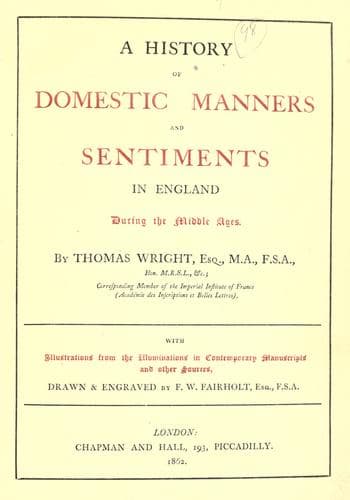
A History of Domestic Manners and Sentiments in England During the Middle AgesWright, Thomas
History
A History of Domestic Manners and Sentiments in England During the Middle Ages
Wright, Thomas
England -- Social life and customs -- 1066-1485
It is very rare that we can catch in history a glimpse of the internal
economy of the Anglo-Saxon household. Enough, however, is told to show
us that the Saxon woman in every class of society possessed those
characteristics which are still considered to be the best traits of
the character of Englishwomen; she was the attentive housewife, the
tender companion, the comforter and consoler of her husband and family,
the virtuous and noble matron. Home was her especial place; for we
are told in a poem in the Exeter Book (p. 337) that, “It beseems a
damsel to be at her board (table); a rambling woman scatters words,
she is often charged with faults, a man thinks of her with contempt,
oft her cheek smites.” In all ranks, from the queen to the peasant,
we find the lady of the household attending to her domestic duties.
In 686, John of Beverley performed a supposed miraculous cure on the
lady of a Yorkshire earl; and the man who narrated the miracle to
Bede the historian, and who dined with John of Beverley at the earl’s
house after the cure, said, “She presented the cup to the bishop
(John) and to me, and continued serving us with drink as she had
begun, till dinner was over.” Domestic duties of this kind were never
considered as degrading, and they were performed with a simplicity
peculiarly characteristic of the age. Bede relates another story of
a miraculous cure performed on an earl’s wife by St. Cuthbert, in
the sequel of which we find the lady going forth from her house to
meet her husband’s visitor, holding the reins while he dismounts, and
conducting him in. The wicked and ambitious queen Elfthrida, when her
step-son king Edward approached her residence, went out in person to
attend upon him, and invite him to enter, and, on his refusal, she
served him with the cup herself, and it was while stooping to take
it that he was treacherously stabbed by one of her attendants. In
their chamber, besides spinning and weaving, the ladies were employed
in needlework and embroidery, and the Saxon ladies were so skilful
in this art, that their work, under the name of English work (_opus
Anglicum_), was celebrated on the continent. We read of a Saxon lady,
named Ethelswitha, who retired with her maidens to a house near Ely,
where her mother was buried, and employed herself and them in making
a rich chasuble for the monks. The four princesses, the sisters of
king Ethelstan, were celebrated for their skill in spinning, weaving,
and embroidering; William of Malmesbury tells us that their father,
king Edward, had educated them “in such wise, that in childhood
they gave their whole attention to letters, and afterwards employed
themselves in the labours of the distaff and the needle.” The reader
will remember in the story of the Saxon queen Osburgha, the mother
of the great Alfred, how she sat in her chamber, surrounded by her
children, and encouraging them in a taste for literature. The ladies,
when thus occupied, were not inaccessible to their friends of either
Public-domain text, read in full here on John Shaqi.
Reviews
Reviews
No reviews yet
Be the first to share your thoughts on this work.
Join the Discussion
Join the discussion
Sign in to leave a comment or review.
Sign InorCreate an account