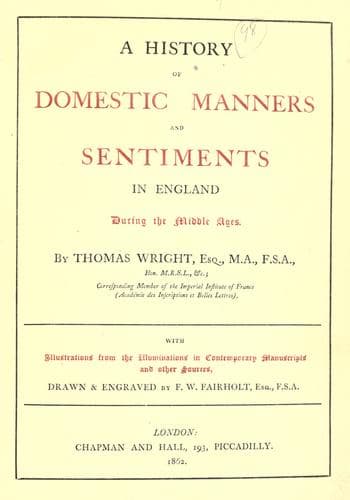
A History of Domestic Manners and Sentiments in England During the Middle AgesWright, Thomas
History
A History of Domestic Manners and Sentiments in England During the Middle Ages
Wright, Thomas
England -- Social life and customs -- 1066-1485
flesh-meat was not in general use for food among the lower classes of
society.
Bread seems almost always to have been formed in cakes, like our buns,
round in the earlier pictures, and in later ones (as in our cut No.
63), shaped more fancifully. We see it generally marked with a cross,
perhaps a superstitious precaution of the baker. The bread seems to
have been in general made for the occasion, and eaten fresh, perhaps
warm. In one of Reginald of Durham’s stories, we are told of a priest
in the forest of Arden, who, having nothing but a peck of corn left,
and receiving a large number of visitors on a sacred festival, gave it
out to be baked to provide for them. The corn was immediately ground,
perhaps with querns, and having been mixed with “dewy” water, in the
usual manner, was made into twelve loaves, and immediately placed in
the hot oven.[19] Cheese and butter seem also to have been tolerably
abundant. An illuminator of the Cambridge MS., given in our cut No.
65, represents a man milking and another churning; he who churns
appears, to use a vulgar phrase, to be “taking it at his ease.” The
milking-pail, too, is rather extraordinary in its form.
[Illustration: _No. 65. Anglo-Normans Milking and Churning._]
We have not any distinct account of the hours at which our Norman
ancestors took their meals, but they appear to have begun their day
early. In the Carlovingian romances, everybody, not excepting the
emperor and his court, rises at daybreak; and in Huon de Bordeaux (p.
270), one of the chief heroes is accused of laziness, because he was in
bed after the cock had crowed. In the romance of Doon de Mayence, the
feudal lord of that great city and territory is introduced exhorting
his son to rise betimes, for, he says, “he who sleeps too long in the
morning, becomes thin and lazy, and loses his day, if he does not amend
himself.”
_Qui trop dort au matin, maigre devient et las,_
_Et sa journée en pert, s’y n’en amende pas._--Doon de Mayence, p. 76.
Public-domain text, read in full here on John Shaqi.
Reviews
Reviews
No reviews yet
Be the first to share your thoughts on this work.
Elsewhere in the archive
Join the Discussion
Join the discussion
Sign in to leave a comment or review.
Sign InorCreate an account