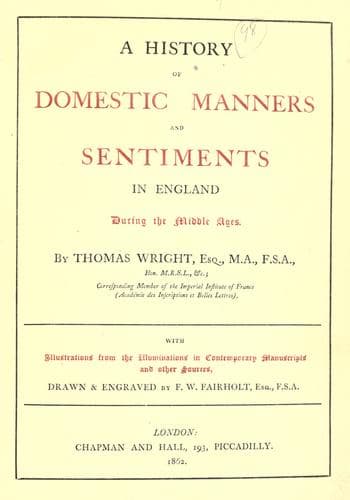
A History of Domestic Manners and Sentiments in England During the Middle AgesWright, Thomas
History
A History of Domestic Manners and Sentiments in England During the Middle Ages
Wright, Thomas
England -- Social life and customs -- 1066-1485
[Illustration: _No. 62. The Servant in the Cellar._]
[Illustration: _No. 63. Anglo-Norman Pottery._]
Wine appears to have been now more frequently used than among the
Anglo-Saxons. Neckam, in the latter part of the twelfth century, has
given us a rather playful enumeration of the qualities of good wine;
which he says should be as clear as the tears of a penitent, so that a
man may see distinctly to the bottom of his glass; its colour “should
represent the greenness of a buffalo’s horn; when drunk, it should
descend impetuously like thunder, sweet-tasted as an almond, creeping
like a squirrel, leaping like a roebuck, strong like the building of a
Cistercian monastery, glittering like a spark of fire, subtle as the
logic of the schools of Paris, delicate as fine silk, and colder than
crystal.” Yet still ale and mead continued to be the usual drinks. The
innumerable entries in Domesday Book show us how large a proportion of
the productions of the country, in the reign of William the Conqueror,
still consisted in honey, which was used chiefly for the manufacture of
mead. The manuscript in Trinity College Library, gives us a group of
bee-hives (cut No. 64), with peasants attending to them; and is chiefly
curious for the extraordinary forms which the artist, evidently no
naturalist, has given to the bees.
[Illustration: _No. 64. Anglo-Norman Bee-keepers._]
We have hardly any information on the cookery during the period we are
now describing. It is clear that numerous delicacies were served to the
tables of the noble and wealthy, but their culinary receipts are not
preserved. We read in William of Malmesbury, incidentally, that a great
prince ate garlick with a goose, from which we are led to suppose that
the Normans were fond of highly-seasoned dishes. Neckam tells us that
pork, roasted or broiled on red embers, required no other sauce than
salt or garlick; that a capon done in gobbets should be well peppered;
that a goose, roasted on the spit, required a strong garlick-sauce,
mixed with wine or “the green juice of grapes or crabs;” that a hen, if
boiled, should be cut up and seasoned with cummin, but, if roasted, it
should be basted with lard, and might be seasoned with garlick-sauce,
though it would be more savoury with simple sauce; that fish should
be cooked in a sauce composed of wine and water, and that they should
afterwards be served with a sauce composed of sage, parsley, cost,
ditany, wild thyme, and garlick, with pepper and salt. We learn from
other incidental allusions of contemporary, or nearly contemporary,
writers, that bread, butter, and cheese, were the ordinary food of
the common people, probably with little else besides vegetables. It
is interesting to remark that the three articles just mentioned, have
preserved their Anglo-Saxon names to the present times, while all kinds
of meat, beef, veal, mutton, pork, even bacon, have retained only
the names given to them by the Normans, which seems to imply that
Public-domain text, read in full here on John Shaqi.
Reviews
Reviews
No reviews yet
Be the first to share your thoughts on this work.
Elsewhere in the archive
Join the Discussion
Join the discussion
Sign in to leave a comment or review.
Sign InorCreate an account