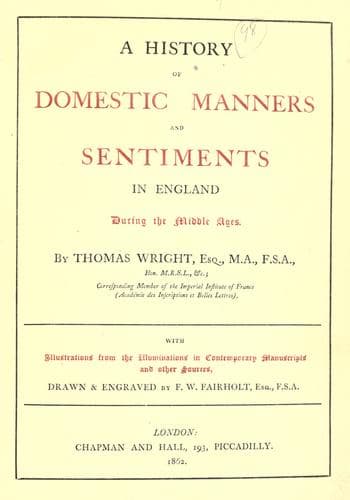
A History of Domestic Manners and Sentiments in England During the Middle Ages — John Shaqi
A History of Domestic Manners and Sentiments in England During the Middle AgesWright, Thomas
History
A History of Domestic Manners and Sentiments in England During the Middle Ages
Wright, Thomas
England -- Social life and customs -- 1066-1485
It came into the mind of Hrothgar, we are told, that he would cause
to be built a house, “a great mead-hall,” which was to be his chief
palace, or metropolis. The hall-gate, we are informed, rose aloft,
“high and curved with pinnacles” (_heáh and horn-geáp_). It is
elsewhere described as a “lofty house;” the hall was high; it was “fast
within and without, with iron bonds, forged cunningly;” it appears that
there were steps to it, and the roof is described as being variegated
with gold; the walls were covered with tapestry (_web æfter wagum_),
which also was “variegated with gold,” and presented to the view “many
a wondrous sight to every one that looketh upon such.” The walls appear
to have been of wood; we are repeatedly told that the roof was carved
and lofty; the floor is described as being variegated (probably a
tesselated pavement); and the seats were benches arranged round it,
with the exception of Hrothgars chair or throne. In the vicinity of
the hall stood the chambers or bowers, in which there were beds (_bed
æfter búrum_).
These few epithets and allusions, scattered through the poem, give us a
tolerable notion of what the house of a Saxon chieftain must have been
in the country from whence our ancestors came, as well as afterwards
in that where they finally settled. The romantic story is taken up
more with imaginary combats with monsters, than with domestic scenes,
but it contains a few incidents of private life. The hall of king
Hrothgar was visited by a monster named Grendel, who came at night to
prey upon its inhabitants; and it was Beowulf’s mission to free them
from this nocturnal scourge. By direction of the primeval coast-guards,
he and his men proceeded by the “street” already mentioned to the hall
of Hrothgar, at the entrance to which they laid aside their armour and
left their weapons. Beowulf found the chief and his followers drinking
their ale and mead, and made known the object of his journey. “Then,”
says the poem, “there was for the sons of the Geats (Beowulf and his
followers), altogether, a bench cleared in the beer-hall; there the
bold of spirit, free from quarrel, went to sit; the thane observed his
office, he that in his hand bare the twisted ale-cup; he poured the
bright sweet liquor; meanwhile the poet sang serene in Heorot (the
name of Hrothgar’s palace), there was joy of heroes.” Thus the company
passed their time, listening to the bard, boasting of their exploits,
and telling their stories, until Wealtheow, Hrothgar’s queen, entered
and “greeted the men in the hall.” She now served the liquor, offering
the cup first to her husband, and then to the rest of the guests, after
which she seated herself by Hrothgar, and the festivities continued
till it was time to retire to bed. Beowulf and his followers were
left to sleep in the hall--“the wine-hall, the treasure-house of men,
variegated with vessels” (_fættum fáhne_). Grendel came in the night,
and after a dreadful combat received his death-wound from Beowulf.
Public-domain text, read in full here on John Shaqi.
Reviews
Reviews
No reviews yet
Be the first to share your thoughts on this work.
Join the Discussion
Join the discussion
Sign in to leave a comment or review.
Sign InorCreate an account