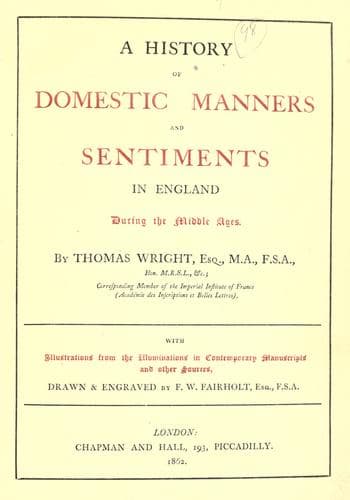
A History of Domestic Manners and Sentiments in England During the Middle AgesWright, Thomas
History
A History of Domestic Manners and Sentiments in England During the Middle Ages
Wright, Thomas
England -- Social life and customs -- 1066-1485
It is hardly necessary to remark that, in the change in the mode of
living which had suddenly taken place in this country, a form of
society had also been introduced abruptly which differed entirely
from that of the Anglo-Saxons. On the continent, throughout the now
disjointed empire which had once been ruled by Charlemagne, there had
arisen, during the tenth century, amid frightful misgovernment and
the savage invasions of the northmen, a new form of society, which
received the name of feudalism, because each landholder held, either
direct from the crown or from a superior baron, by a feudal tenure, or
fee (_feodum_, _feudum_), which obliged him to military service. Each
baron had sovereignty over all those who held under him, and, in turn,
acknowledged the nominal sovereignty of a superior baron or of the
crown, which the latter practically was only sometimes able to enforce.
One great principle of this system was the right of private warfare;
and, as not only did the great barons obtain land in feudal tenure in
different countries under different independent princes, but the lesser
holders of sub-fees obtained such tenures under more than one superior
lord, and as these, when they quarrelled with one superior, made war
upon him, and threw themselves upon the protection of another who felt
bound to defend his feudatory, war became the normal state of feudal
society, and peace and tranquillity were the exceptions. One effect of
feudalism was to divide the population of the country into two distinct
classes--the landholders, or fighting-men, who alone were free, and
the agricultural population, who had no political rights whatever,
and were little better than slaves attached to the land. The towns
alone, by their own innate force, preserved their independence, but
in France the influence of feudalism extended even over them, and the
combined hostility of the crown and the aristocracy finally overthrew
their municipal independence. Feudalism was brought into England by the
Normans, but it was never established here so completely or so fully
as on the continent. The towns here never lost their independence,
but they sided sometimes with the aristocracy, and sometimes with
the crown, until finally they assisted greatly in the overthrow
of feudalism itself. Yet the whole territory of England was now
distributed in great fees, and in sub-fees; amid which a few of the old
Saxon gentry retained their position, and many of the Norman intruders
married the Saxon heiresses, in order, as they thought, to strengthen
the right of conquest; but the mass of the agricultural population were
confounded under the one comprehensive name of _villains_ (_villani_),
and reduced to a much more wretched condition than under the
Anglo-Saxon constitution. The light in which the villain was regarded
in the twelfth century in England is well illustrated in a story told
in the English “Rule of Nuns,” printed by the Camden Society. A knight,
Public-domain text, read in full here on John Shaqi.
Reviews
Reviews
No reviews yet
Be the first to share your thoughts on this work.
Elsewhere in the archive
Join the Discussion
Join the discussion
Sign in to leave a comment or review.
Sign InorCreate an account