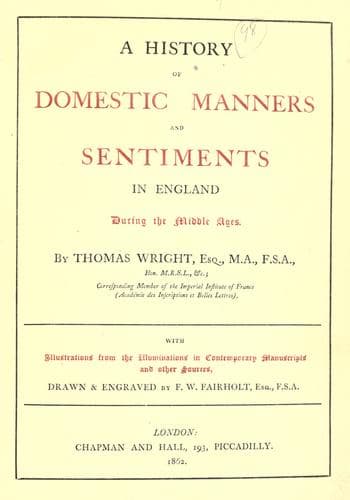
A History of Domestic Manners and Sentiments in England During the Middle AgesWright, Thomas
History
A History of Domestic Manners and Sentiments in England During the Middle Ages
Wright, Thomas
England -- Social life and customs -- 1066-1485
who had cruelly plundered his poor villains, was complimented by one
of his flatterers, who said, “Ah, sir! truly thou dost well. For men
ought always to pluck and pillage the churl, who is like the willow--it
sprouteth out the better for being often cropped.”
The power and wealth of the great Norman baron were immense, and
before him, during a great part of the period of which we are now
speaking, the law of the land was a mere nominal institution. He was
in general proud, very tyrannical, and often barbarously cruel. A type
of the feudal baron in his worst point of view is presented to us in
the character of the celebrated Robert de Belesme, who succeeded his
father Roger de Montgomery in the earldom of Shropshire, and of whom
Henry of Huntingdon, who lived in his time, tells us, “He was a very
Pluto, Megæra, Cerberus, or anything that you can conceive still more
horrible. He preferred the slaughter of his captives to their ransom.
He tore out the eyes of his own children, when in sport they hid their
faces under his cloak. He impaled persons of both sexes on stakes. To
butcher men in the most horrible manner was to him an agreeable feast.”
Of a contemporary feudal chieftain in France, the same writer tells
us, “When any one, by fraud or force, fell into his hands, the captive
might truly say, ‘The pains of hell compassed me round.’ Homicide
was his passion and his glory. He imprisoned his own countess, an
unheard-of outrage; and, cruel and lewd at once, while he subjected
her to fetters and torture by day, to extort money, he forced her to
cohabit with him by night, in order to mock her. Each night his brutal
followers dragged her from her prison to his bed, each morning they
carried her from his chamber back to her prison. Amicably addressing
any one who approached him, he would plunge a sword into his side,
laughing the while; and for this purpose he carried his sword naked
under his cloak more frequently than sheathed. Men feared him, bowed
down to him, and worshipped him.” Women of rank are met with in the
histories of this period who equalled these barons in violence and
cruelty; and the relations between the sexes were marked by little
delicacy or courtesy. William the Conqueror beat his wife even before
they were married. The aristocratic class in general lived a life of
idleness, which would have been insupportable without some scenes
of extraordinary excitement, and they not only indulged eagerly in
hunting, but they continually sallied forth in parties to plunder. They
looked upon the mercantile class especially as objects of hostility;
and, as they could seldom overcome them in their towns, they waylaid
them on the public roads, deprived them of their goods and money, and
carried them to their castles, where they tortured them in order to
force them to pay heavy ransoms. The young nobles sometimes joined
together to plunder a fair or market. On the other hand, men who could
Public-domain text, read in full here on John Shaqi.
Reviews
Reviews
No reviews yet
Be the first to share your thoughts on this work.
Elsewhere in the archive
Join the Discussion
Join the discussion
Sign in to leave a comment or review.
Sign InorCreate an account