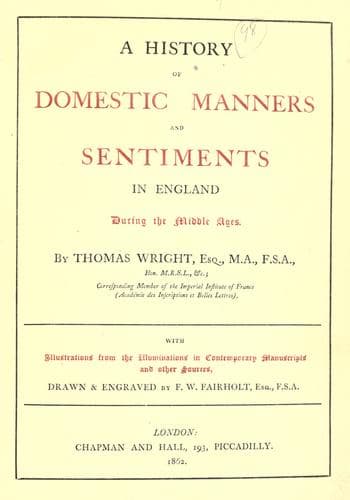
A History of Domestic Manners and Sentiments in England During the Middle AgesWright, Thomas
History
A History of Domestic Manners and Sentiments in England During the Middle Ages
Wright, Thomas
England -- Social life and customs -- 1066-1485
letchers (_lecheurs_) were not content with waiting for what was sent
away from table, but seized upon the dishes as they were carried from
the kitchen to the hall, and how it was found necessary to make a new
office, that of ushers of the hall, to repress the disorder. “In those
great courts,” says the author of the “Rule of Nuns,” “they are called
letchers who have so lost shame, that they are ashamed of nothing, but
seek how they may work the greatest villany.” This class spread through
society like a great sore, and from the terms used in speaking of them
we derive a great part of the opprobrious words which still exist in
the English language.
The early metrical romances of the Carlovingian cycle give us an
insight into what were considered as the praiseworthy features in the
character of the feudal knight. In Doon of Mayence, for example, when
(p. 74) the aged count Guy sends his young son Doon into the world, he
counsels him thus: “You shall always ask questions of good men, and
you shall never put your trust in a stranger. Every day, fair son, you
shall hear the holy mass, and give to the poor whenever you have money,
for God will repay you double. Be liberal in gifts to all; for the more
you give, the more honour you will acquire, and the richer you will be;
for a gentleman who is too sparing will lose all in the end, and die
in wretchedness and disgrace; but give without promising wherever you
can. Salute all people when you meet them, and if you owe anything, pay
it willingly, but if you cannot pay, ask for a respite. When you come
to the hostelry, don’t stand squabbling, but enter glad and joyously.
When you enter the house, cough very loud, for there may be something
doing which you ought not to see, and it will cost you nothing to give
this notice of your approach, while those who happen to be there will
love you the better for it. Do not quarrel with your neighbour, and
avoid disputing with him before other people; for if he know anything
against you, he will let it out, and you will have the shame of it.
When you are at court, play at tables, and if you have any good points
of behaviour (_depors_), show them; you will be the more prized, and
gain the more advantage. Never make a noise or joke in church; this is
only done by unbelievers, whom God loves not. Honour all the clergy,
and speak fairly to them, but leave them as little of your goods as
you can; the more they get from you, the more you will be laughed
at; you will never profit by enriching them. And if you wish to save
your honour undiminished, meddle with nothing you do not understand,
and don’t pretend to be a proficient in what you have never learnt.
And if you have a valet, take care not to seat him at the table by
you, or take him to bed with you; for the more honour you do to a low
fellow, the more will he despise you. If you should know anything that
you would wish to conceal, tell it by no means to your wife, if you
Public-domain text, read in full here on John Shaqi.
Reviews
Reviews
No reviews yet
Be the first to share your thoughts on this work.
Elsewhere in the archive
Join the Discussion
Join the discussion
Sign in to leave a comment or review.
Sign InorCreate an account