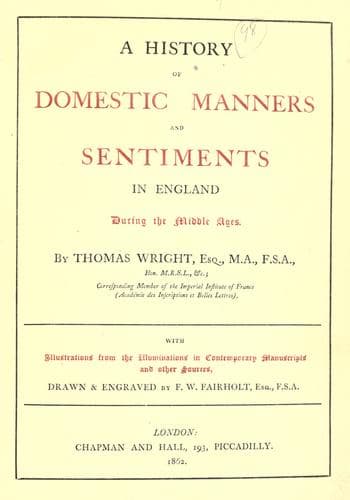
A History of Domestic Manners and Sentiments in England During the Middle AgesWright, Thomas
History
A History of Domestic Manners and Sentiments in England During the Middle Ages
Wright, Thomas
England -- Social life and customs -- 1066-1485
not claim the protection of aristocratic blood for their evil deeds,
established themselves under that of the wild forests, and issued
forth no less eagerly to plunder the country, and to perpetrate every
description of outrage on the persons of its inhabitants, of whatever
class they might be, who fell into their power. The purity of womanhood
was no longer prized, where it was liable to be outraged with impunity;
and immorality spread widely through all classes and ranks of society.
The declamations of the ecclesiastics and the satires of the moralists
of the twelfth century may give highly-painted pictures, but they lead
us to the conclusion that the manners and sentiments of the female sex
during the Norman period were very corrupt.
Nevertheless, feudalism did boast of certain dignified and generous
principles, and there were noble examples of both sexes, who shine
forth more brightly through the general prevalence of vice and of
selfishness and injustice. It was in the walls of the feudal castle,
amid the familiar intercourse which the want of amusement caused
among its inmates, that the principle, or practice, arose, which we
in modern times call gallantry, and which, though at first it only
led to refinement in the forms of social manners, ended in producing
refinement of sentiments. It was among the feudal aristocracy, too,
that originated the sentiment we term chivalry, which has varied
considerably in its meaning at different periods, and which, in
its best sense, existed more in romance than in reality. After the
possession of personal strength and courage, the quality which the
feudal baron admired most, was what was termed generosity, but which
meant lavish expenditure and extravagance; it was the contrast between
the baron, who spent his money, and the burgher or merchant, who gained
it, and laid it up in his coffers. “Noblemen and gentlemen,” says the
“Rule of Nuns,” already quoted, “do not carry packs, nor go about
trussed with bundles, nor with purses; it belongs to beggars to bear
bag on back, and to burgesses to bear purses.” In fact, it was the
principle of the feudal aristocracy to extort their gains from all who
laboured and trafficked, in order to squander them on those who lived
in idleness, violence, and vice. Under such circumstances, a new class
had arisen which was peculiar to feudal society, who lived entirely
upon the extravagance of the aristocracy, and who had so completely
abandoned every sentiment of morality or shame, that, in return for
the protection of the nobles, they were the ready instruments of any
base work. They were called, among various other names, _ribalds_
(_ribaldi_) and _letchers_ (_leccatores_); the origin of the first of
these words is not known, but the latter is equivalent to dish-lickers,
and did not convey the sense now given to the word, but was applied
to them on account of their gluttony. We have already seen how, in
the crowd which attended the feasts of the princes and nobles, the
Public-domain text, read in full here on John Shaqi.
Reviews
Reviews
No reviews yet
Be the first to share your thoughts on this work.
Elsewhere in the archive
Join the Discussion
Join the discussion
Sign in to leave a comment or review.
Sign InorCreate an account