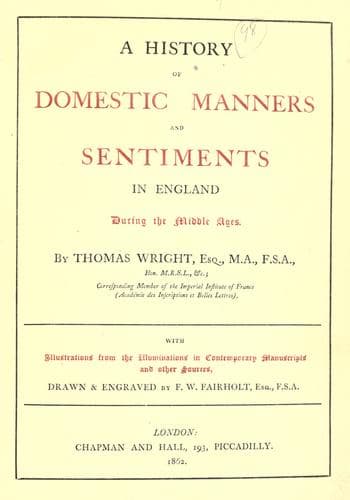
A History of Domestic Manners and Sentiments in England During the Middle AgesWright, Thomas
History
A History of Domestic Manners and Sentiments in England During the Middle Ages
Wright, Thomas
England -- Social life and customs -- 1066-1485
These remarks on the general character of the house are, of course,
intended to apply to the ordinary dwelling-house, and not to the more
extensive mansion--which already in the thirteenth century was made to
surround, wholly or partly, an interior court--or to the castle. These
more extensive edifices consisted only of a greater accumulation of
the rooms and details which were found in the smaller house. During
the thirteenth and fourteenth centuries, no great change took place in
the general characteristics of a private house. The hall was still the
largest and most important room, and was now usually raised on an under
vaulted room, which, to whatever use it may have been applied, was
usually called the _cellar_. Part of it appears to have been sometimes
employed as the stable. In the carpenter’s house, in Chaucer’s Milleres
Tale, the hall, which is evidently the main part of the building, was
open to the roof, with cross beams, on which they hanged the troughs,
and the stable was attached to it, and intervened between the house
and the garden. In the Cokes Tale of Gamelyn, the hall has its posts,
or columns, and there is attached to it a room called a _spence_,
which was more frequently called the _buttery_, in which victuals of
different kinds, and the wine and plate, were locked up, and the man
who had the charge of it was called the _spencer_ or _despencer_, which
it is hardly necessary to say was the origin of two common English
surnames. The gentleman’s house, in Chaucer’s Sompnoures Tale, was
a “large halle,” and is called a _court_, which had now become an
ordinary term for a manor-house.
_A stordy paas doun to the court he goth,_
_Wher as ther wonyd a man of gret honour._
--Chaucer’s Cant. Tales, l. 7,744.
In the Nonne Prestes Tale, the poor widow’s cottage also has its hall
and _bour_, or chamber, although they were all sooty, of course, from
the fires, which had no chimney to carry off the smoke.
_Ful sooty was hir bour, and eek hir halle._
--Ib. l. 16,318.
This house was situated within a court, or, as it is called, _yard_,
which was enclosed by a hedge of sticks, and by a ditch:--
_A yerd sche had, enclosed al aboute_
_With stikkes, and a drye dich withoute._
In the Tale of Gamelyn, the yard, or court, as we use the Anglo-Saxon
or the Anglo-Norman name for it, had a stronger fence, with a gate
and wicket fastened by lock and bolt, and apparently a lodge for the
porter. In the yard there was a draw-well, seven fathoms deep. While
Gamelyn took possession of the hall, his brother shut himself up in the
cellar, which could be made a safe place of refuge, when all the rest
of the house was in the power of an enemy. The yard here had also a
postern-gate. In the carpenter’s house, in Chaucer’s Milleres Tale, the
chamber has a low window, to swing outwardly--
Public-domain text, read in full here on John Shaqi.
Reviews
Reviews
No reviews yet
Be the first to share your thoughts on this work.
Elsewhere in the archive
Join the Discussion
Join the discussion
Sign in to leave a comment or review.
Sign InorCreate an account