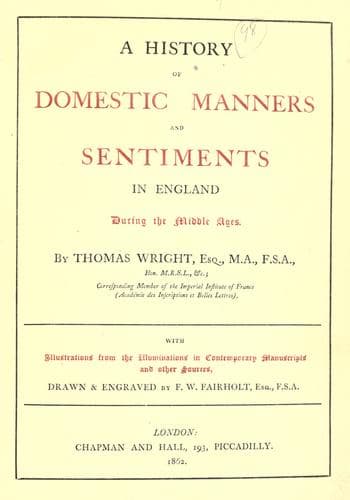
A History of Domestic Manners and Sentiments in England During the Middle AgesWright, Thomas
History
A History of Domestic Manners and Sentiments in England During the Middle Ages
Wright, Thomas
England -- Social life and customs -- 1066-1485
_So mote I thryve, I schal at cokkes crowe_
_Ful pryvely go knokke at his wyndowe,_
_That stant ful lowe upon his bowres wal--_
which is immediately afterwards called the “schot wyndowe”--
_Unto his brest it raught, it was so lowe._
A new apartment had now been added to the house, called in Anglo-Norman
a parlour (_parloir_), because it was literally the talking-room. It
belonged originally to the monastic houses, where the parlour was the
room for receiving people who came to converse on business, and, when
introduced into private houses, it was a sort of secondary hall, where
visitors might be received more privately than in the great hall, and
yet with less familiarity than in the chamber. In the story of Sir
Cleges, the knight finds the king seated in his parlour, and listening
to a harper. In a Latin document of the year 1473, printed in Rymer’s
Fœdera, a citizen of London has, in his mansion-house there, a parlour
adjoining the garden (_in quadam parlura adjacente gardino_).
Houses were, as I have before stated, usually built in great part of
timber, and it was only where unusual strength was required, or else
from a spirit of ostentation, that they were made of stone. There
appear to have been very few fixtures in the inside, and, as furniture
was scanty, the rooms must have appeared very bare. In timber houses,
of course, it was not easy to make cupboards or closets in the walls,
but this was not the case when they were built of stone. Even in the
latter case, however, the walls appear not to have been much excavated
for such purposes. Our cut No. 89 represents a cupboard door, taken
from an illuminated manuscript of the thirteenth century, in the
Bodleian Library at Oxford; it is curious for its ironwork, especially
the lock and key. The smaller articles of domestic use were usually
deposited in chests, or placed upon sideboards and moveable stands. In
the houses of the wealthy a separate room was built for the wardrobe.
[Illustration: _No. 89. A Cupboard Door._]
[Illustration: _No. 90. The Cellarer of St. Alban’s._]
Public-domain text, read in full here on John Shaqi.
Reviews
Reviews
No reviews yet
Be the first to share your thoughts on this work.
Elsewhere in the archive
Join the Discussion
Join the discussion
Sign in to leave a comment or review.
Sign InorCreate an account