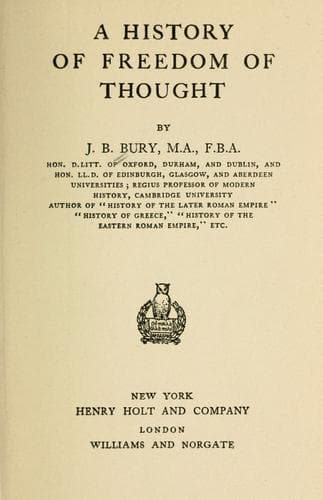
A History of Freedom of ThoughtBury, J. B. (John Bagnell)
Religion
A History of Freedom of Thought
Bury, J. B. (John Bagnell)
Free thought -- History; Rationalism -- History
[225] of public opinion) during the last thirty years. A generation ago
Lord Morley wrote: “The preliminary stage has scarcely been reached—the
stage in which public opinion grants to every one the unrestricted right
of shaping his own beliefs, independently of those of the people who
surround him.” I think this preliminary stage has now been passed. Take
England. We are now far from the days when Dr. Arnold would have sent
the elder Mill to Botany Bay for irreligious opinions. But we are also
far from the days when Darwin’s Descent created an uproar. Darwin has
been buried in Westminster Abbey. To-day books can appear denying the
historical existence of Jesus without causing any commotion. It may be
doubted whether what Lord Acton wrote in 1877 would be true now: “There
are in our day many educated men who think it right to persecute.” In
1895, Lecky was a candidate for the representation of Dublin University.
His rationalistic opinions were indeed brought up against him, but he
was successful, though the majority of the constituents were orthodox.
In the seventies his candidature would have been hopeless. The old
commonplace that a freethinker is sure to be immoral is no longer heard.
We may say that we have now
[226] reached a stage at which it is admitted by every one who counts
(except at the Vatican), that there is nothing in earth or heaven which
may not legitimately be treated without any of the assumptions which in
old days authority used to impose.
In this brief review of the triumphs of reason in the nineteenth
century, we have been considering the discoveries of science and
criticism which made the old orthodoxy logically untenable. But the
advance in freedom of thought, the marked difference in the general
attitude of men in all lands towards theological authority to-day from
the attitude of a hundred years ago, cannot altogether be explained by
the power of logic. It is not so much criticism of old ideas as the
appearance of new ideas and interests that changes the views of men at
large. It is not logical demonstrations but new social conceptions that
bring about a general transformation of attitude towards ultimate
problems. Now the idea of the progress of the human race must, I think,
be held largely answerable for this change of attitude. It must, I
think, be held to have operated powerfully as a solvent of theological
beliefs. I have spoken of the teaching of Diderot and his friends that
man’s energies should be devoted to making the earth pleasant. A
Public-domain text, read in full here on John Shaqi.
Reviews
Reviews
No reviews yet
Be the first to share your thoughts on this work.
Elsewhere in the archive
Join the Discussion
Join the discussion
Sign in to leave a comment or review.
Sign InorCreate an account