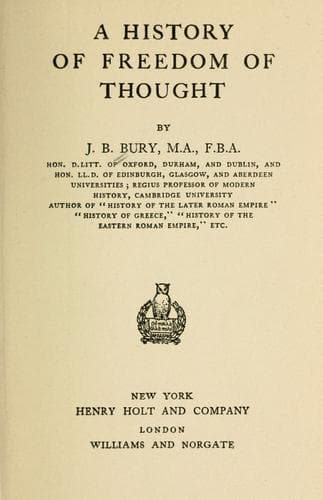
A History of Freedom of ThoughtBury, J. B. (John Bagnell)
Religion
A History of Freedom of Thought
Bury, J. B. (John Bagnell)
Free thought -- History; Rationalism -- History
[227] new ideal was substituted for the old ideal based on theological
propositions. It inspired the English Utilitarian philosophers (Bentham,
James Mill, J. S. Mill, Grote) who preached the greatest happiness of
the greatest number as the supreme object of action and the basis of
morality. This ideal was powerfully reinforced by the doctrine of
historical progress, which was started in France (1750) by Turgot, who
made progress the organic principle of history. It was developed by
Condorcet (1793), and put forward by Priestley in England. The idea was
seized upon by the French socialistic philosophers, Saint-Simon and
Fourier. The optimism of Fourier went so far as to anticipate the time
when the sea would be turned by man’s ingenuity into lemonade, when
there would be 37 million poets as great as Homer, 37 million writers as
great as Molière, 37 million men of science equal to Newton. But it was
Comte who gave the doctrine weight and power. His social philosophy and
his religion of Humanity are based upon it. The triumphs of science
endorsed it; it has been associated with, though it is not necessarily
implied in, the scientific theory of evolution; and it is perhaps fair
to say that it has been the guiding spiritual force of the nineteenth
century. It has introduced
[228] the new ethical principle of duty to posterity. We shall hardly be
far wrong if we say that the new interest in the future and the progress
of the race has done a great deal to undermine unconsciously the old
interest in a life beyond the grave; and it has dissolved the blighting
doctrine of the radical corruption of man.
Nowhere has the theory of progress been more emphatically recognized
than in the Monistic movement which has been exciting great interest in
Germany (1910–12). This movement is based on the ideas of Haeckel, who
is looked up to as the master; but those ideas have been considerably
changed under the influence of Ostwald, the new leader. While Haeckel is
a biologist, Ostwald’s brilliant work was done in chemistry and physics.
The new Monism differs from the old, in the first place, in being much
less dogmatic. It declares that all that is in our experience can be the
object of a corresponding science. It is much more a method than a
system, for its sole ultimate object is to comprehend all human
experience in unified knowledge. Secondly, while it maintains, with
Haeckel, evolution as the guiding principle in the history of living
things, it rejects his pantheism and his theory of thinking atoms. The
old mechanical theory of the
Public-domain text, read in full here on John Shaqi.
Reviews
Reviews
No reviews yet
Be the first to share your thoughts on this work.
Elsewhere in the archive
Join the Discussion
Join the discussion
Sign in to leave a comment or review.
Sign InorCreate an account