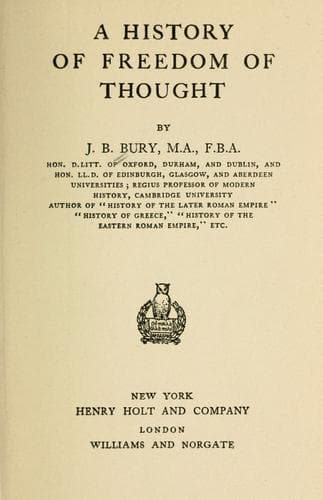
A History of Freedom of ThoughtBury, J. B. (John Bagnell)
Religion
A History of Freedom of Thought
Bury, J. B. (John Bagnell)
Free thought -- History; Rationalism -- History
[231] Western Europe, in which the majority of Christians are Catholics,
we see how the ideal of progress, freedom of thought, and the decline of
ecclesiastical power go together. In Spain, where the Church has
enormous power and wealth and can still dictate to the Court and the
politicians, the idea of progress, which is vital in France and Italy,
has not yet made its influence seriously felt. Liberal thought indeed is
widely spread in the small educated class, but the great majority of the
whole population are illiterate, and it is the interest of the Church to
keep them so. The education of the people, as all enlightened Spaniards
confess, is the pressing need of the country. How formidable are the
obstacles which will have to be overcome before modern education is
allowed to spread was shown four years ago by the tragedy of Francisco
Ferrer, which reminded everybody that in one corner of Western Europe
the mediaeval spirit is still vigorous. Ferrer had devoted himself to
the founding of modern schools in the province of Catalonia (since
1901). He was a rationalist, and his schools, which had a marked
success, were entirely secular. The ecclesiastical authorities execrated
him, and in the summer of 1909 chance gave them the means of destroying
him. A strike of workmen at
[232] Barcelona developed into a violent revolution, Ferrer happened to
be in Barcelona for some days at the beginning of the movement, with
which he had no connection whatever, and his enemies seized the
opportunity to make him responsible for it. False evidence (including
forged documents) was manufactured. Evidence which would have helped his
case was suppressed. The Catholic papers agitated against him, and the
leading ecclesiastics of Barcelona urged the Government not to spare the
man who founded the modern schools, the root of all the trouble. Ferrer
was condemned by a military tribunal and shot (Oct. 13). He suffered in
the cause of reason and freedom of thought, though, as there is no
longer an Inquisition, his enemies had to kill him under the false
charge of anarchy and treason. It is possible that the indignation which
was felt in Europe and was most loudly expressed in France may prevent
the repetition of such extreme measures, but almost anything may happen
in a country where the Church is so powerful and so bigoted, and the
politicians so corrupt.
[1] From Greek monos, alone.
[2] Besides the works referred to in the text, may be mentioned: Winwood
Reade, Martyrdom of Man, 1871; Mill, Three Essays on Religion; W. R.
Cassels, Supernatural Religion; Tyndall, Address to British Association
at Belfast; Huxley, Animal Automatism; W. K. Clifford, Body and Mind;
all in 1874.
Public-domain text, read in full here on John Shaqi.
Reviews
Reviews
No reviews yet
Be the first to share your thoughts on this work.
Elsewhere in the archive
Join the Discussion
Join the discussion
Sign in to leave a comment or review.
Sign InorCreate an account