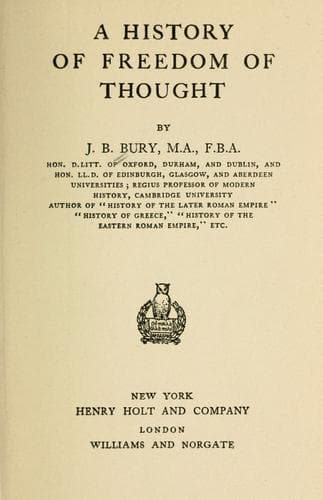
A History of Freedom of ThoughtBury, J. B. (John Bagnell)
Religion
A History of Freedom of Thought
Bury, J. B. (John Bagnell)
Free thought -- History; Rationalism -- History
[229] physical world has been gradually supplanted by the theory of
energy, and Ostwald, who was one of the foremost exponents of energy,
has made it a leading idea of Monism. What has been called matter is, so
far as we know now, simply a complex of energies, and he has sought to
extend the “energetic” principle from physical or chemical to
biological, psychical, and social phenomena. But it is to be observed
that no finality is claimed for the conception of energy; it is simply
an hypothesis which corresponds to our present stage of knowledge, and
may, as knowledge advances, be superseded.
Monism resembles the positive philosophy and religion of Comte in so far
as it means an outlook on life based entirely on science and excluding
theology, mysticism, and metaphysics. It may be called a religion, if we
adopt Mr. MacTaggart’s definition of religion as “an emotion resting on
a conviction of the harmony between ourselves and the universe at
large.” But it is much better not to use the word religion in connexion
with it, and the Monists have no thought of finding a Monistic, as Comte
founded a Positivist, church. They insist upon the sharp opposition
between the outlook of science and the outlook of religion, and find the
mark of spiritual progress in the fact that religion is
[230] gradually becoming less indispensable. The further we go back in
the past, the more valuable is religion as an element in civilization;
as we advance, it retreats more and more into the background, to be
replaced by science. Religions have been, in principle, pessimistic, so
far as the present world is concerned; Monism is, in principle,
optimistic, for it recognizes that the process of his evolution has
overcome, in increasing measure, the bad element in man, and will go on
overcoming it still more. Monism proclaims that development and progress
are the practical principles of human conduct, while the Churches,
especially the Catholic Church, have been steadily conservative, and
though they have been unable to put a stop to progress have endeavoured
to suppress its symptoms—to bottle up the steam. [6] The Monistic
congress at Hamburg in 1911 had a success which surprised its promoters.
The movement bids fair to be a powerful influence in diffusing
rationalistic thought. [7]
If we take the three large States of
Public-domain text, read in full here on John Shaqi.
Reviews
Reviews
No reviews yet
Be the first to share your thoughts on this work.
Elsewhere in the archive
Join the Discussion
Join the discussion
Sign in to leave a comment or review.
Sign InorCreate an account