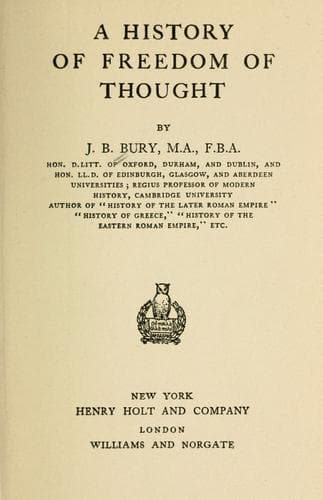
A History of Freedom of ThoughtBury, J. B. (John Bagnell)
Religion
A History of Freedom of Thought
Bury, J. B. (John Bagnell)
Free thought -- History; Rationalism -- History
Once the principle of liberty of thought is accepted as a supreme
condition of social progress, it passes from the sphere of ordinary
expediency into the sphere of higher expediency which we call justice.
In other words it becomes a right on which every man should be able to
count. The fact that this right is ultimately based on utility does not
justify a government in curtailing it, on the ground of utility, in
particular cases.
The recent rather alarming inflictions of penalties for blasphemy in
England illustrate this point. It was commonly supposed that the
Blasphemy laws (see above, p. 139), though unrepealed, were a dead
letter. But since December, 1911, half a dozen persons have been
imprisoned for this offence. In these cases Christian doctrines were
attacked by poor and more or less uneducated persons in language which
may be described as coarse and offensive. Some of the judges seem to
have taken the line that it is not blasphemy to attack the fundamental
doctrines provided “the decencies of controversy” are preserved, but
that “indecent” attacks constitute blasphemy. This implies a new
definition of legal blasphemy, and is entirely contrary to the intention
of the laws. Sir
[245] J. F. Stephen pointed out that the decisions of judges from the
time of Lord Hale (XVIIth century) to the trial of Foote (1883) laid
down the same doctrine and based it on the same principle: the doctrine
being that it is a crime either to deny the truth of the fundamental
doctrines of the Christian religion or to hold them up to contempt or
ridicule; and the principle being that Christianity is a part of the law
of the land.
The apology offered for such prosecutions is that their object is to
protect religious sentiment from insult and ridicule. Sir J. F. Stephen
observed: “If the law were really impartial and punished blasphemy only,
because it offends the feelings of believers, it ought also to punish
such preaching as offends the feelings of unbelievers. All the more
earnest and enthusiastic forms of religion are extremely offensive to
those who do not believe them.” If the law does not in any sense
recognize the truth of Christian doctrine, it would have to apply the
same rule to the Salvation Army. In fact the law “can be explained and
justified only on what I regard as its true principle—the principle of
persecution.” The opponents of Christianity may justly say: If
Christianity is false, why is it to be attacked only in polite language?
Its goodness depends on its truth. If you
[246] grant its falsehood, you cannot maintain that it deserves special
protection. But the law imposes no restraint on the Christian, however
offensive his teaching may be to those who do not agree with him;
therefore it is not based on an impartial desire to prevent the use of
language which causes offence; therefore it is based on the hypothesis
that Christianity is true; and therefore its principle is persecution.
Public-domain text, read in full here on John Shaqi.
Reviews
Reviews
No reviews yet
Be the first to share your thoughts on this work.
Elsewhere in the archive
Join the Discussion
Join the discussion
Sign in to leave a comment or review.
Sign InorCreate an account