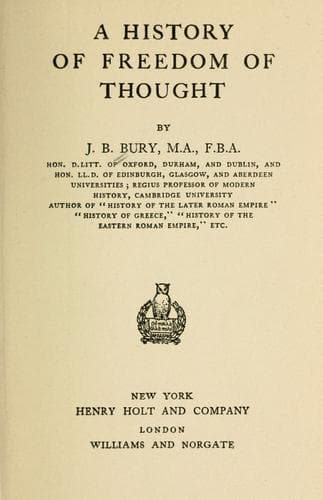
A History of Freedom of ThoughtBury, J. B. (John Bagnell)
Religion
A History of Freedom of Thought
Bury, J. B. (John Bagnell)
Free thought -- History; Rationalism -- History
Of course, the present administration of the common law in regard to
blasphemy does not endanger the liberty of those unbelievers who have
the capacity for contributing to progress. But it violates the supreme
principle of liberty of opinion and discussion. It hinders uneducated
people from saying in the only ways in which they know how to say it,
what those who have been brought up differently say, with impunity, far
more effectively and far more insidiously. Some of the men who have been
imprisoned during the last two years, only uttered in language of
deplorable taste views that are expressed more or less politely in books
which are in the library of a bishop unless he is a very ignorant
person, and against which the law, if it has any validity, ought to have
been enforced. Thus the law, as now administered, simply penalizes bad
taste and places disabilities
[247] upon uneducated freethinkers. If their words offend their audience
so far as to cause a disturbance, they should be prosecuted for a breach
of public order, [1] not because their words are blasphemous. A man who
robs or injures a church, or even an episcopal palace, is not prosecuted
for sacrilege, but for larceny or malicious damage or something of the
kind.
The abolition of penalties for blasphemy was proposed in the House of
Commons (by Bradlaugh) in 1889 and rejected. The reform is urgently
needed. It would “prevent the recurrence at irregular intervals of
scandalous prosecutions which have never in any one instance benefited
any one, least of all the cause which they were intended to serve, and
which sometimes afford a channel for the gratification of private malice
under the cloak of religion.” [2]
The struggle of reason against authority has ended in what appears now
to be a decisive and permanent victory for liberty. In the most
civilized and progressive countries, freedom of discussion is recognized
as a
Public-domain text, read in full here on John Shaqi.
Reviews
Reviews
No reviews yet
Be the first to share your thoughts on this work.
Elsewhere in the archive
Join the Discussion
Join the discussion
Sign in to leave a comment or review.
Sign InorCreate an account