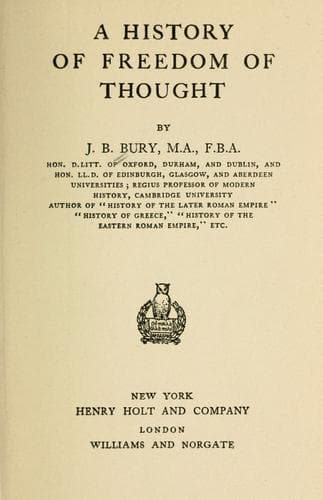
A History of Freedom of ThoughtBury, J. B. (John Bagnell)
Religion
A History of Freedom of Thought
Bury, J. B. (John Bagnell)
Free thought -- History; Rationalism -- History
[250] to suppress one of them successfully. But once it is agreed by all
astronomers that the earth goes round the sun, it is a hopeless task for
any authority to compel men to accept a false view. In short, because
she is in possession of a vast mass of ascertained facts about the
nature of the universe, reason holds a much stronger position now than
at the time when Christian theology led her captive. All these facts are
her fortifications. Again, it is difficult to see what can arrest the
continuous progress of knowledge in the future. In ancient times this
progress depended on a few; nowadays, many nations take part in the
work. A general conviction of the importance of science prevails to-day,
which did not prevail in Greece. And the circumstance that the advance
of material civilization depends on science is perhaps a practical
guarantee that scientific research will not come to an abrupt halt. In
fact science is now a social institution, as much as religion.
But if science seems pretty safe, it is always possible that in
countries where the scientific spirit is held in honour, nevertheless,
serious restrictions may be laid on speculations touching social,
political, and religious questions. Russia has men of science inferior
to none, and Russia has its notorious censorship. It
[251] is by no means inconceivable that in lands where opinion is now
free coercion might be introduced. If a revolutionary social movement
prevailed, led by men inspired by faith in formulas (like the men of the
French Revolution) and resolved to impose their creed, experience shows
that coercion would almost inevitably be resorted to. Nevertheless,
while it would be silly to suppose that attempts may not be made in the
future to put back the clock, liberty is in a far more favourable
position now than under the Roman Empire. For at that time the social
importance of freedom of opinion was not appreciated, whereas now, in
consequence of the long conflict which was necessary in order to re-
establish it, men consciously realize its value. Perhaps this conviction
will be strong enough to resist all conspiracies against liberty.
Meanwhile, nothing should be left undone to impress upon the young that
freedom of thought is an axiom of human progress. It may be feared,
however, that this is not likely to be done for a long time to come. For
our methods of early education are founded on authority. It is true that
children are sometimes exhorted to think for themselves. But the parent
or instructor who gives this excellent advice is confident that the
results of the child’s thinking for
Public-domain text, read in full here on John Shaqi.
Reviews
Reviews
No reviews yet
Be the first to share your thoughts on this work.
Elsewhere in the archive
Join the Discussion
Join the discussion
Sign in to leave a comment or review.
Sign InorCreate an account