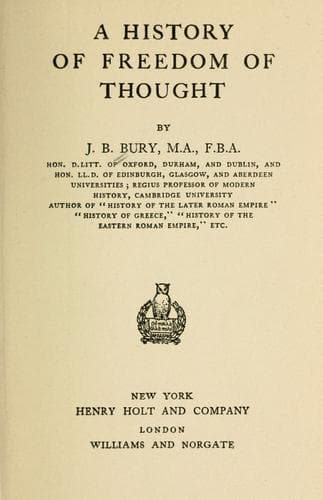
A History of Freedom of ThoughtBury, J. B. (John Bagnell)
Religion
A History of Freedom of Thought
Bury, J. B. (John Bagnell)
Free thought -- History; Rationalism -- History
[248] fundamental principle. In fact, we may say it is accepted as a
test of enlightenment, and the man in the street is forward in
acknowledging that countries like Russia and Spain, where opinion is
more or less fettered, must on that account be considered less civilized
than their neighbours. All intellectual people who count take it for
granted that there is no subject in heaven or earth which ought not to
be investigated without any deference or reference to theological
assumptions. No man of science has any fear of publishing his
researches, whatever consequences they may involve for current beliefs.
Criticism of religious doctrines and of political and social
institutions is free. Hopeful people may feel confident that the victory
is permanent; that intellectual freedom is now assured to mankind as a
possession for ever; that the future will see the collapse of those
forces which still work against it and its gradual diffusion in the more
backward parts of the earth. Yet history may suggest that this prospect
is not assured. Can we be certain that there may not come a great set-
back? For freedom of discussion and speculation was, as we saw, fully
realized in the Greek and Roman world, and then an unforeseen force, in
the shape of Christianity, came in and laid chains upon the human mind
and
[249] suppressed freedom and imposed upon man a weary struggle to
recover the freedom which he had lost. Is it not conceivable that
something of the same kind may occur again? that some new force,
emerging from the unknown, may surprise the world and cause a similar
set-back?
The possibility cannot be denied, but there are some considerations
which render it improbable (apart from a catastrophe sweeping away
European culture). There are certain radical differences between the
intellectual situation now and in antiquity. The facts known to the
Greeks about the nature of the physical universe were few. Much that was
taught was not proved. Compare what they knew and what we know about
astronomy and geography—to take the two branches in which (besides
mathematics) they made most progress. When there were so few
demonstrated facts to work upon, there was the widest room for
speculation. Now to suppress a number of rival theories in favour of one
is a very different thing from suppressing whole systems of established
facts. If one school of astronomers holds that the earth goes round the
sun, another that the sun goes round the earth, but neither is able to
demonstrate its proposition, it is easy for an authority, which has
coercive power,
Public-domain text, read in full here on John Shaqi.
Reviews
Reviews
No reviews yet
Be the first to share your thoughts on this work.
Elsewhere in the archive
Join the Discussion
Join the discussion
Sign in to leave a comment or review.
Sign InorCreate an account