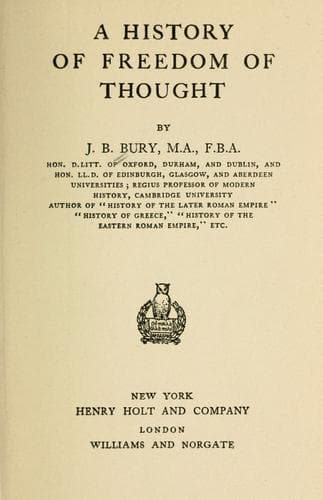
A History of Freedom of ThoughtBury, J. B. (John Bagnell)
Religion
A History of Freedom of Thought
Bury, J. B. (John Bagnell)
Free thought -- History; Rationalism -- History
[31] with all who would listen to him—to bring all popular beliefs
before the bar of reason, to approach every inquiry with an open mind,
and not to judge by the opinion of majorities or the dictate of
authority; in short to seek for other tests of the truth of an opinion
than the fact that it is held by a great many people. Among his
disciples were all the young men who were to become the leading
philosophers of the next generation and some who played prominent parts
in Athenian history.
If the Athenians had had a daily press, Socrates would have been
denounced by the journalists as a dangerous person. They had a comic
drama, which constantly held up to ridicule philosophers and sophists
and their vain doctrines. We possess one play (the Clouds of
Aristophanes) in which Socrates is pilloried as a typical representative
of impious and destructive speculations. Apart from annoyances of this
kind, Socrates reached old age, pursuing the task of instructing his
fellow-citizens, without any evil befalling him. Then, at the age of
seventy, he was prosecuted as an atheist and corrupter of youth and was
put to death (399 B.C.). It is strange that if the Athenians really
thought him dangerous they should have suffered him so long. There can,
I think, be
[32] little doubt that the motives of the accusation were political. [1]
Socrates, looking at things as he did, could not be sympathetic with
unlimited democracy, or approve of the principle that the will of the
ignorant majority was a good guide. He was probably known to sympathize
with those who wished to limit the franchise. When, after a struggle in
which the constitution had been more than once overthrown, democracy
emerged triumphant (403 B.C.), there was a bitter feeling against those
who had not been its friends, and of these disloyal persons Socrates was
chosen as a victim. If he had wished, he could easily have escaped. If
he had given an undertaking to teach no more, he would almost certainly
have been acquitted. As it was, of the 501 ordinary Athenians who were
his judges, a very large minority voted for his acquittal. Even then, if
he had adopted a different tone, he would not have been condemned to
death.
He rose to the great occasion and vindicated freedom of discussion in a
wonderful unconventional speech. The Apology of Socrates, which was
composed by his most brilliant pupil, Plato the philosopher, reproduces
[33] the general tenor of his defence. It is clear that he was not able
to meet satisfactorily the charge that he did not acknowledge the gods
worshipped by the city, and his explanations on this point are the weak
part of his speech. But he met the accusation that he corrupted the
minds of the young by a splendid plea for free discussion. This is the
most valuable section of the Apology; it is as impressive to-day as
ever. I think the two principal points which he makes are these—
Public-domain text, read in full here on John Shaqi.
Reviews
Reviews
No reviews yet
Be the first to share your thoughts on this work.
Join the Discussion
Join the discussion
Sign in to leave a comment or review.
Sign InorCreate an account